The Merge
In military aviation, "the merge" is the moment when two opposing aircraft pass each other. The pilot identifies an oncoming aircraft, and as the aircraft pass each other, the pilot turns to get in behind the other aircraft. This is a standard manoeuvre that all fighter pilots train for.
The AWACS video shows the F-16 turning to the left after passing the Partnair aircraft—consistent with the initiation of such a manoeuvre. The F-16 pilot likely assumed that the Partnair aircraft was the last of the fighter jets coming towards him on the same route, and acted accordingly.
Speed and distance
At speeds exceeding 1,000 km/h, there is no time to think and analyse. The pilot acts on reflexes ingrained through training. The timing for when the turn is initiated, and how hard one turns, is based on experience with opposing aircraft moving at a speed comparable to one's own.
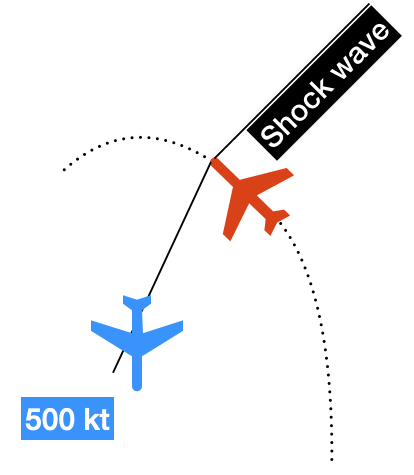
When the opposing aircraft is a fighter jet at 500 knots, both aircraft are moving rapidly away from the point of passing. When the F-16 pilot begins the turn, the opposing aircraft has already covered a considerable distance. The result is that the turn occurs at a relatively large distance from the other aircraft.
Merge against a fighter jet at 500 knots—large distance at the turn. |
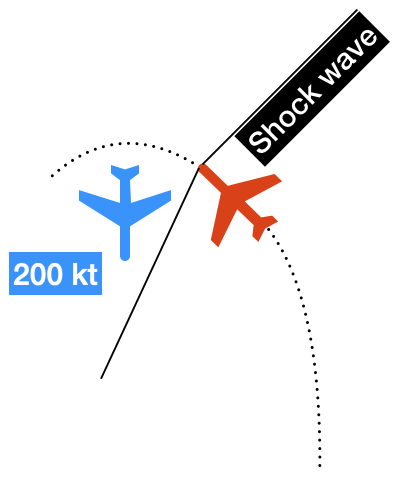
When the opposing aircraft is instead a propeller aircraft at 200 knots, the situation changes dramatically. The pass itself is experienced almost identically—the closure rate is still enormous. But after the pass, the Partnair aircraft is moving at only one-third the speed of a fighter jet. When the F-16 pilot initiates the turn based on trained timing, the distance to the Partnair aircraft is substantially shorter than it would have been against a fighter jet. The result is that the F-16 turns in much closer behind the Partnair aircraft than the pilot had anticipated.
Merge against a propeller aircraft at 200 knots—much closer at the turn. |
The pilot has no opportunity to correct. Everything happens too fast. Before the pilot can react to the distance being less than expected, the F-16 has already passed.
The Shock Wave Strikes from the Side
When the F-16 turns behind the Partnair aircraft, the shock wave from the F-16 is directed at the Partnair aircraft's side. At speeds near the speed of sound, the shock wave propagates nearly perpendicularly from the F-16. As the F-16 passes behind and to the side of the Partnair aircraft, the shock wave strikes the Partnair aircraft's fuselage and tail control surfaces from the side.
The fact that the shock wave strikes from the side has two important consequences: the entire length of the aircraft's fuselage is exposed to the pressure change, and the rudder—which stands vertically on the tail—is struck head-on. When the F-16 additionally passes at the same altitude as the Partnair aircraft, the shock wave strikes the tail control surfaces directly, without any dampening angle from above or below.
The most vulnerable part of the tail structure is the rudder's trim tab—a small surface mounted on the rudder. The trim tab is naturally not designed to withstand forces as great as the rest of the rudder, since it is only intended to help fine-tune the position of the control surface. If the trim tab is knocked out of position or physically damaged by a shock wave, it could trigger large aerodynamic forces that may be catastrophic.
The combination of an unexpectedly close pass and a shock wave striking the rudder's trim tab directly from the side, at the same altitude, constitutes a direct threat to the weakest part of the aircraft's tail structure.