Radar Echoes of Wreckage
In addition to the detailed radar plots from Skagen radar, the accident report contains radar data from Sweden showing that over the course of half an hour, parts from the aircraft descended towards the sea surface. Maps of the wreckage area show where the various parts of the aircraft were recovered. Without collating the information, it is difficult to obtain a clear picture of what happened and when. This chapter contains images from the accident report with annotations to make it easier to see the connection between the different data sources.
The accident investigation board's hypothesis is that shroud doors between the control surfaces and the stabilisers were shattered early in the accident sequence, while the aircraft was still at cruise altitude, and that the honeycomb material from these shroud doors is what was observed on radar. This hypothesis is central to the accident investigation board's conclusion that vibrations in the tail section developed over time.
An analysis of radar data and physical calculations shows, however, that the objects registered on radar separated from the aircraft in the very last phase of the accident—when the tail section collapsed and the pressure cabin ruptured—and not in an early phase of the accident sequence.
Swedish Radar Data
The Swedish Armed Forces delivered radar data to the Swedish accident investigation board, which forwarded them to the Norwegian accident investigation board on 11 October 1989. The document describes the observations from the Swedish west coast radar film.
The Swedish document establishes that the aircraft was at approximately 5,000 metres altitude (approximately 16,400 feet) until approximately 14:37:40, based on rough calculations from which radar stations detected and lost the target. Furthermore, a radar echo is described that is assumed to originate from objects that separated from the aircraft:
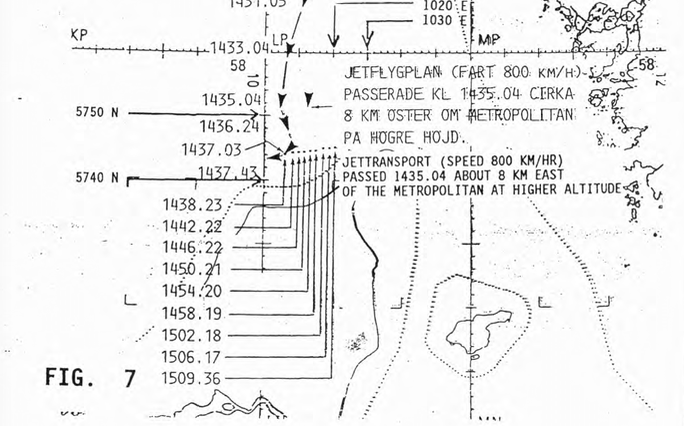
«Appendix 2 shows the movement of a radar echo that is assessed to have consisted of objects that separated from the accident aircraft while it was still at a minimum altitude of 5,000 metres.» (Forssberg, 1989, p. 2)
(The Accident Report, 1993, Figure 7) |
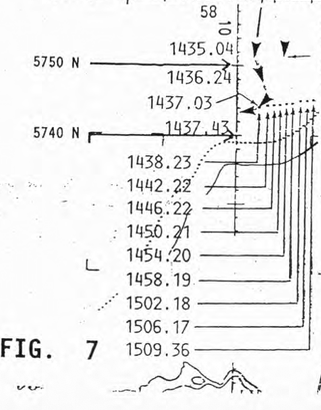
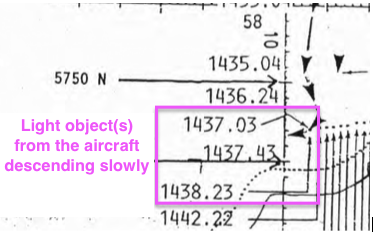
The object was visible on the west coast radar film for just over 31 minutes and drifted approximately 14.5 km eastward with the wind. When it disappeared from the radar, the altitude is estimated to have been approximately 400 metres, with a rate of descent of approximately 2.5 metres per second.
The fact that the Swedish assessment states «a minimum altitude of 5,000 metres» (approximately 16,400 feet) is consistent with the aircraft already having lost several thousand feet from its cruise altitude of 22,000 feet (6,700 metres) before the objects separated. This is consistent with an accident sequence in which the aircraft first entered a dive and lost 5,000–7,000 feet in altitude before the tail section collapsed.
Descending Object
From radar data, it is difficult to know whether one object was registered or whether there were several. For simplicity, «the object» is used here, while in reality there may have been many objects.
To understand what the radar data shows, it is essential to establish when the object left the aircraft. The Swedish radar data shows that the aircraft passes a given point at 14:37:03. At approximately the same location, radar data shows the object in the air 80 seconds later (at 14:38:23). This means that the object left the aircraft further to the west and was then carried back eastward by the wind.
The Swedish radar data covers the entire flight and is not as precise as the plot from Skagen radar. Based on the Swedish radar film, approximately 80 seconds elapse from the aircraft passing until the object is registered back at approximately the same point. Using the plot from Skagen radar, which has higher resolution, the corresponding time is approximately 93 seconds.
Calculation of Separation Time
By calculating the distance the object has travelled, it is possible to estimate approximately when the object detached from the aircraft.
Assumptions
At the time of the accident, there was a 70-knot wind from 260° at the altitude the aircraft was at. The object has therefore moved at a ground speed of 70 knots in approximately the opposite direction to the aircraft after it separated.
Based on performance data (Pilot's Handbook Convair 580, 1977, p. 4-7), a Convair 580 will have an average true airspeed of approximately 300 knots at 22,000 feet altitude. Given that the final portion of the flight was heading almost directly into the wind, the ground speed would have been approximately 230 knots.
The calculation is based on the principle that the total time—from the aircraft passing the reference point until the object is observed back at the same point—equals the sum of the aircraft's flight time forward and the object's drift time back with the wind:
Flight time + drift time = 80 seconds |
Calculation at 230 knots ground speed (normal cruise speed)
Parameter | Value |
Wind eastward (wreckage) | 70 knop = 36,0 m/s |
Aircraft ground speed westward | 230 knop = 118,3 m/s |
Flight time before separation | 19,0 seconds |
Drift time back | 62,4 seconds |
Sum | 81,4 seconds |
Calculation at 130 knots ground speed (dive with reduced ground speed)
If the aircraft was in a dive, the velocity vector points downward rather than forward. The horizontal component—ground speed—can thus become substantially lower than during normal cruise, even though the aircraft's speed through the air increases.
Parameter | Value |
Wind eastward (wreckage) | 70 knop = 36,0 m/s |
Aircraft ground speed westward | 130 knop = 66,9 m/s |
Flight time before separation | 28,0 seconds |
Drift time back | 52,0 seconds |
Sum | 80,0 seconds |
Calculation at 330 knots ground speed (dive with increased ground speed)
Depending on the dive angle, ground speed may also be higher than normal, if the aircraft is not diving steeply but accelerating in a shallow descent.
Parameter | Value |
Wind eastward (wreckage) | 70 knop = 36,0 m/s |
Aircraft ground speed westward | 330 knop = 169,8 m/s |
Flight time before separation | 14,0 seconds |
Drift time back | 66,0 seconds |
Sum | 80,0 seconds |
Result
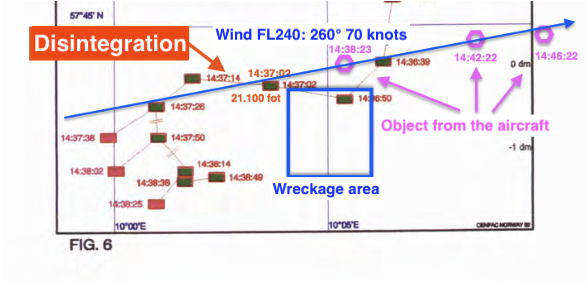
Depending on the aircraft's ground speed in the final phase, the objects detached between 14 and 28 seconds after the aircraft passed the reference point. Based on the Skagen radar plot, this corresponds to a time between approximately 14:37:04 and 14:37:24. Regardless of which ground speed is assumed, this time window coincides with the final radar registrations of the aircraft—and not with an early phase of the accident sequence.
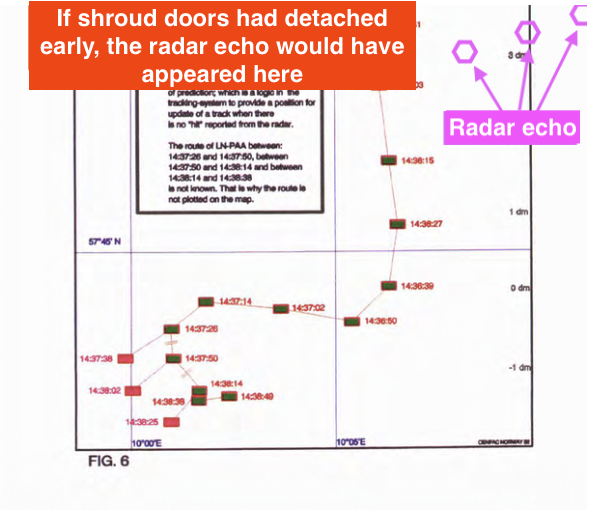
The calculations above are based on the radar plot from Skagen, which is a NATO radar. There is reason to question the accuracy of these data, which is discussed further in a later chapter. The most important point, however, is that the Swedish civilian radar independently confirms the same picture: the objects separated from the aircraft too late to have originated from an early phase of the accident sequence. The point at which the aircraft departs controlled flight is also visible on the Swedish radar. Had the objects detached at cruise altitude—early in the process—they would have appeared on the Swedish radar at a substantially earlier time and further north than where they were actually registered.
(The Accident Report, 1993, Figure 6) Skagen radar data with annotations. |
The Wreckage Area
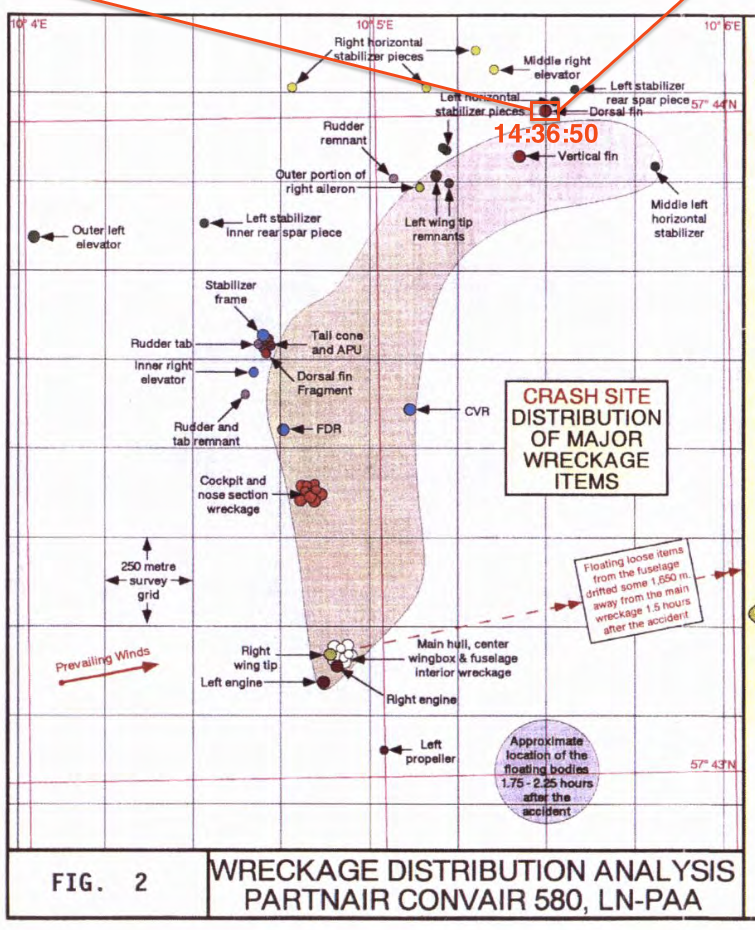
When the aircraft broke up in the air, air resistance brought the aircraft's forward motion to a halt in a short time. This is visible in the radar data, which shows the aircraft moving less forward after the time of the accident than previously. According to the accident report, horizontal surfaces in the tail broke off, and the aircraft then entered a manoeuvre with so much negative g that the wings broke:
«The technical findings and radar data provide several indications of the subsequent course of events. In broad terms, stability about the lateral axis was also lost when horizontal surfaces in the tail broke off. After this, the aircraft entered a manoeuvre with so much negative g that the wings broke.» (The Accident Report, 1993, p. 108)
Data from Skagen radar indicates that the final radar registration was at 14:38:49.
(Accident Investigation & Research, 1992, Figure 2) |
Altitude Indication in Radar Data
Radar data from Skagen shows a Mode C registration of 21,100 feet at 14:37:10. A Mode C registration requires that the aircraft's transponder transmitted pressure altitude information. The accident investigation board has concluded that the transponder at this point was receiving power from the aircraft's 12-volt battery.
There are, however, strong physical arguments that this altitude indication cannot be correct:
Assertion 1: The Time Conflict
In free fall from 22,000 feet, it takes approximately 1 minute and 40 seconds to reach the sea surface. The Partnair aircraft hit the sea surface at approximately 14:39—approximately two minutes after it was allegedly at 21,100 feet. The fuselage did not, however, fall straight down, but flew through the air with wings that still provided aerodynamic lift in varying directions depending on the fuselage's orientation. The radar track confirms that the aircraft did not fall vertically. It is therefore not physically possible that the aircraft was at 21,100 feet at 14:37:02 and hit the sea surface two minutes later.
Assertion 2: The Tail Section Must Have Broken After a Dive
For flutter to develop in the control surfaces, a speed far exceeding normal cruise speed is required. Such a speed can only be achieved through a dive with significant altitude loss. According to an expert assessment from a person with intimate knowledge of the aircraft type—as a mechanic, pilot, and instructor—an altitude loss of 5,000–7,000 feet over approximately one minute would likely provide sufficient speed for flutter to develop.
After flutter has destroyed the control surfaces, it is not physically possible for the aircraft to maintain altitude. The elevator contributes to giving the horizontal stabilisers negative lift in order to keep the aircraft's nose up. Without this negative lift, the nose-heavy aircraft will pitch downward.
The aircraft therefore cannot have been at 21,100 feet at 14:37:02, since at this point it had already been through a dive with several thousand feet of altitude loss and subsequent collapse of the control surfaces.
Conclusion Regarding Altitude Data
The aircraft was in a dive and descending after having lost control. The tail control surfaces eventually collapsed, and at that point there was no return—it is physically impossible for the pilots to bring the aircraft back up to altitude without functioning control surfaces. Radar data from Skagen showing 21,100 feet at 14:37:02 therefore cannot have been real.
The Swedish radar analysis supports this:
«Our data does not contain any altitude measurements. Rough assessments of the aircraft's altitude have, however, been possible based on where different radar stations detected and lost the target. Up until approximately 1437.40, the aircraft was still at approximately 5,000 metres altitude. (It was then visible on a radar in south-eastern Sweden.) As shown in the sketch, the last presentation on the west coast radar occurred at 1437.43. The aircraft is therefore assessed to have plunged steeply into the sea.» (Forssberg, 1989, p. 2)
Swedish radar thus estimates the aircraft's altitude at approximately 5,000 metres (16,400 feet) at 14:37:40—only 38 seconds after Skagen radar allegedly registered 21,100 feet. This contradiction confirms that the altitude indication from Skagen cannot have been correct.
Objects Observed by Civilian Radar
The accident investigation board's hypothesis is that shroud doors from the tail section detached early in the accident sequence, while the aircraft was at cruise altitude, and that the honeycomb material from these panels explains the radar echoes. There are several problems with this hypothesis.
The radar beam from a civilian primary radar of the 1980s requires a reflective area of approximately 100 square centimetres or greater for reliable detection. The shroud doors are relatively small, and when they break into smaller pieces and fall rotating downward, it is very unlikely that they would produce continuous radar reflections. Radar reflection can in theory be based on many small objects in proximity to one another that collectively produce a reflection, but for this purpose the shroud doors are too small for fragments of them alone to explain the observed radar reflections.
(Accident Investigation & Research, 1992, Figure 3) Shroud doors (number 3 in the diagram) |
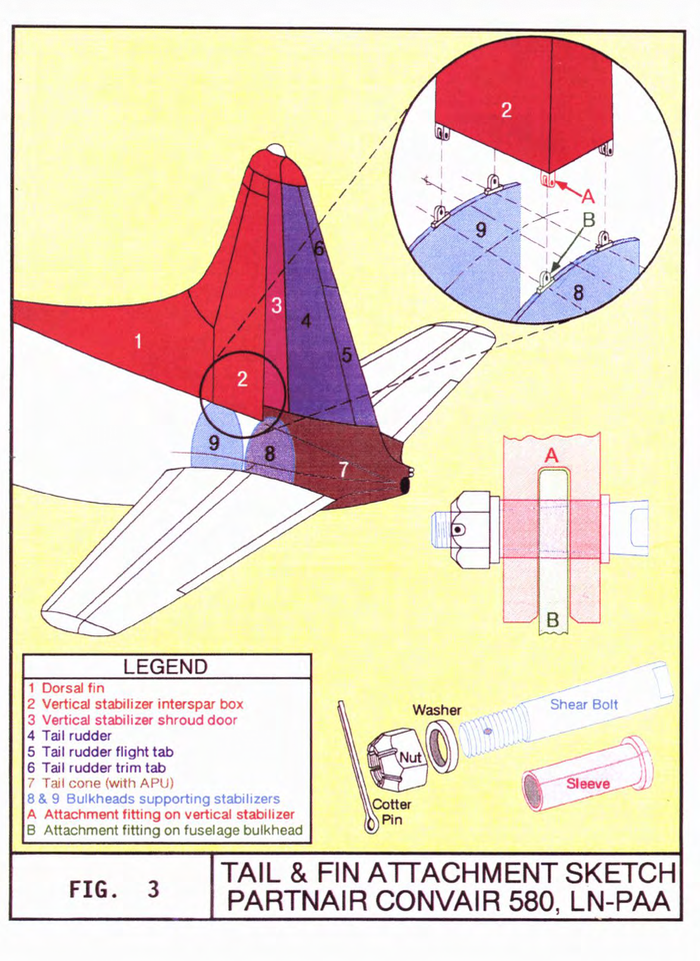
The only logical explanation is that the radar reflections are caused by wreckage from both the inside and outside of the aircraft when the tail section broke off and the pressure cabin ruptured. The catastrophic decompression caused objects from the inside of the aircraft to be ejected in addition to the fuselage itself breaking apart. Thousands of parts of varying size and radar-reflective properties were scattered throughout the altitude range—the lightest parts drifted with the wind and took a long time to reach the sea surface. The parts that spread vertically collectively produced clear primary radar reflections and were registered by both Swedish and Danish radar.
Had the shroud doors actually detached in an early phase of the accident sequence—while the aircraft was still at cruise altitude and cruise speed further north—the radar echo would have appeared at an entirely different location than where it was observed. The radar plot shows, however, that the objects appear at a position that coincides with the calculated time of the aircraft's final disintegration.
(The Accident Report, 1993, Figure 3) Skagen radar data annotated. |
(The Accident Report, 1993, Figure 7) Wreckage registered by Swedish radar. |
«The starting point was that the object must have been small and very light. It must also have had excellent reflection properties for radar-transmitted energy. The object was registered for 2,473 seconds (41 minutes and 13 seconds). … Because this "honeycomb" was the only material on the aircraft that could satisfy the requirements for low weight per unit area and perfect reflection of radar energy, HSL concludes that the object registered by Swedish radar and Aalborg approach radar was one or more pieces of "honeycomb" from the vertical fin's shroud doors.» (The Accident Report, 1993, pp. 81–82)
Aalborg Approach Radar
The radar at Aalborg and Copenhagen registered an apparently stationary object in the air above the accident site.
«The approach radar at Aalborg airport was also used to search for LN-PAA. The controller and his assistant observed an apparently stationary object at position radial 360° 16 NM from Sindal airfield. … It was also of interest that Copenhagen ACC radar registered "something" 40 NM north of Aalborg at 1445. This coincides with the position of the object registered by the approach radar at Aalborg airport.» (The Accident Report, 1993, p. 80)
The Aalborg report describes the observation in detail:
«At approximately 1455 UTC, LLyt (OF) received an inquiry from the Control Centre (ACC) as to whether a transponder track of an aircraft could be observed on LLyt's radar, last seen 30 NM north of Aalborg, estimated to be over Aalborg; transponder code 1211. The transponder track could not be observed on LLyt's radar. At this point, OF and RN were only attempting to observe transponder tracks. Approximately two minutes later, LLyt (RN) received the same request from ACC, after which LLyt also began observing for primary radar tracks. Immediately, OF and RN observed a stationary primary radar echo approximately one NM outside the 40 NM radar distance ring, due north of Sindal airfield, which corresponds to a position 16 NM on radial 360 relative to Sindal airfield. As the weather caused many rain showers on the radar, with the possibility of confusing primary radar echoes and rain, all showers were removed from the radar using the rain filter. The primary echo 16 NM north of Sindal was not diminished, and remained the size of a primary echo from an aircraft. In the area surrounding this primary echo, no other primary echoes, stationary or moving, were observed. The observation continued until 1520 UTC. The time at which the primary echo disappeared is not known. The minimum altitude at which LLyt's radar could detect primary echoes at the position 16 NM north of Sindal was, on that particular evening, approximately 2,000 feet. This was established through overflights of the area.» (Nielsen, 1989, p. 2)
The report shows that the controllers at Aalborg observed a stationary object on the radar in the vicinity of the accident site immediately after they began looking for primary radar echoes. Primary radar relies solely on reflected radar beams and is not dependent on an active response from a transponder, as secondary radar is. The object was visible on the radar from when the observation began, at approximately 14:57, until 15:20.
Shroud Doors and the Accident Investigation Board's Hypothesis
The accident investigation board claims that the rudder deflected beyond its normal travel in both directions, struck the shroud doors, shattered them, and released honeycomb that produced the radar echoes:
«The technical investigations have shown that the rudder deflected beyond its normal travel in both directions. As a result, the rudder's balance weights struck the shroud doors, shattered them, and released honeycomb that was part of the structure of the shroud doors. The investigation has established that only this material, sheets of aluminium honeycomb, could have produced the radar echo that was observed by Swedish radar and by the approach radar at Aalborg airport. On the exterior of the aircraft, there were no other materials or composite structures that could satisfy the criteria with respect to density, geometric shape, and reflection value. The radar observations show that honeycomb was released at high altitude, most probably already at cruise altitude. When the aircraft is in motion at cruise speed, the forces required to give the rudder full deflection are so great that it is not possible to transmit them through the control system. The oscillations can therefore not have been initiated by the crew or the autopilot, or by a fault in the control linkages or transmission system.
For the rudder to have made such deflections while the aircraft was at cruise speed, it must have been subjected to abnormal aerodynamic forces, possibly combined with mechanically transmitted forces from the vertical stabiliser (tail fin).» (The Accident Report, 1993, p. 100)
«It is the commission's view that the oscillations in the fin reached a level where the rudder was affected both aerodynamically through disturbances in the airflow, and that mechanical forces were transmitted through the rudder hinges. This effect set the rudder into oscillations that the rudder's balance weights eventually did not have the capacity to dampen. When the shroud doors were shattered, the conditions were further worsened by the increase in turbulence in the gap between the rudder and the fin.» (The Accident Report, 1993, p. 101)
The Aircraft Manufacturer's Assessment
The accident investigation board received a response from Convair, the aircraft manufacturer, regarding experience with damage to shroud doors. The response paints a substantially different picture from what the accident investigation board assumed:
«In regard to the yaw produced by a failure of the shroud panels, we have no test data available. We have, however, gone through our correspondence files from 1952 through the present time. This search showed that we have received reports from the operators telling us of delaminated shroud panels both on the vertical and the horizontal stabilizers. In one case a horizontal stabilizer shroud panel was completely delaminated for a length of two feet. This panel was replaced. None of these reports contained any mention of adverse flight control conditions resulting from the delamination. We have issued repair limits for delamination of these panels and published it in our 440 Structural Repair Manual.
In only one instance was any mention made as to the reaction of the airplane to a problem such as this. This incident was a case where the horizontal stabilizer shroud panel hinge pin had backed out of the hinge for a distance of 30 inches, leaving the end of the shroud panel loose. The report stated that the end of the panel protruded into the airstream causing heavy control forces. Convair subsequently issued service bulletin 640(340D) S.B. No. 55-1 to improve the method of retention of the hinge pins. A copy of the first page of this bulletin is enclosed for your information.
In addition the above our file search revealed several cases of torn balance curtains. We have also issued repair information for rips and tears in the curtains. No specific limitations were given except that if the repairs caused the control forces to feel high, the curtain must be replaced. Since we found no reports of a massive failure or loss of a shroud panel, we cannot comment specifically on the effect of such a failure. It is apparent, however, that the normal in-service delamination that have been experienced in the past did not result in an airplane control problem to the extent that it was considered reportable to Convair.» (General Dynamics, 1991, pp. 1–2)
Convair's own review of correspondence spanning nearly 40 years shows that delamination of shroud doors has occurred on both vertical and horizontal stabilisers—in one case over a length of two feet—without any problems with the aircraft's handling being reported. The accident investigation board has apparently assumed that the destruction of the shroud doors in itself dramatically worsened the situation, but this stands in contrast to Convair's experience data.
Military Radar
The wreckage was registered by both Swedish and Danish civilian radar. Military radar in the area would most likely also have registered the same observations, but no radar data has been received from the Armed Forces, and there are no statements regarding what their primary radar observed after the accident.
Conclusion
The accident investigation board has overlooked elementary logical flaws that should have been discussed:
- Flutter requires a dive. Flutter cannot have developed in the control surfaces without the aircraft being in a dive, given that the control surfaces were intact at cruise speed. Damage due to a close pass has been excluded by the accident investigation board, which has concluded that the F-16 was never in the vicinity of the Partnair aircraft.
- A dive means altitude loss. The aircraft must have lost many thousands of feet to achieve speeds that produce flutter, and therefore cannot have been at cruise altitude (21,100 feet) as Mode C radar data shows at 14:37:02.
- The radar echo shows late separation. The calculations show that the objects registered by Swedish radar separated from the aircraft in the final phase of the accident—at the calculated time of disintegration—and not in an early phase. Had the shroud doors fallen off while the aircraft was at cruise altitude further north, the radar echo would have appeared at an entirely different location.
- Convair's experience data. The manufacturer's own review shows that delamination of shroud doors has never resulted in reported handling problems, which weakens the hypothesis that destruction of shroud doors in itself dramatically worsened the situation.
An erroneous altitude indication via Mode C cannot be explained away by the radar system's prediction logic. This is the clearest evidence that there are errors in the radar data for the accident sequence.
A more probable hypothesis is that damage occurred in the rudder and developed to become catastrophic. The shroud doors were likely knocked loose midway through the accident sequence, but not while the aircraft was at cruise altitude. The aircraft dived, and as it rapidly lost altitude, flutter developed due to overspeed. When the tail section disintegrated, the pressure cabin ruptured and thousands of parts were ejected. It is this wreckage that was observed by Swedish and Danish radar.
It is difficult to understand why the accident investigation board overlooked these logical flaws. The simplest explanation is that they concluded early on that the cause was play in hinges and unhardened bolts that caused vibrations, and that they subsequently only interpreted observations and findings in a manner that supported this conclusion.