Airspeed
The accident investigation board assumed that the normal cruise speed for LN-PAA was 200 knots. They appear to have focused solely on the indicated airspeed recorded by the Flight Data Recorder, without accounting for the inaccuracy inherent in this recording. The accident investigation board noted that the speed decreased from 215 to 200 knots, without discussing the cause of the speed loss. Depending on weight and cruise altitude, a cruise speed of 200 knots may in some cases be normal, but the speed reduction after "top of climb" is not normal regardless of altitude and total weight.
To substantiate the premise that the airspeed was normal, the accident investigation board should have more closely examined whether the correct speed was recorded by the Flight Data Recorder, and why the speed was decreasing rather than remaining stable. The accident investigation board failed to do this.
«When the aircraft established itself at cruise altitude, the indicated airspeed increased from 185 KT and then decreased to 200 KT.» (The Accident Report, 1993, p. 38)
«At this point, the engines were probably set to cruise setting. Thereafter, the speed decreased until at approximately 32 min FDR time it stabilised at approximately 200 KT.» (The Accident Report, 1993, p. 106)
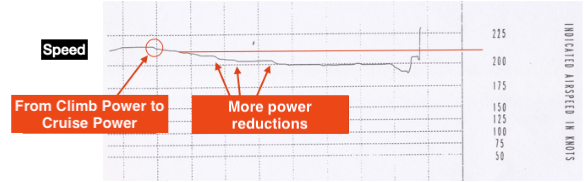
Another important observation is that the speed decreased from 215 knots down to 200 knots over a period of 3 minutes and 45 seconds. Any reduction in speed when setting the engines from "climb power" to "cruise power" occurs within a matter of seconds.
To support the claim that the aircraft was at cruise speed when the accident occurred, the accident report relies on Turbine Inlet Temperature (TIT), which is used in connection with adjusting the engines. Convair pilots are meticulous about using the throttle levers to fine-tune the temperature to 847 °C. The temperatures the accident investigation board read from the instruments show that the engines had a higher temperature than this when the instruments lost power. Rather than discussing this discrepancy, the accident investigation board chose to "round off" the values and conclude that the engines were set to "cruise power."
It is plausible that the throttle levers had been set to approximate "cruise power" shortly before the accident, without the crew having prioritised fine-tuning them as they normally would have done. In such a scenario, the instruments could show approximately normal "cruise power" values, despite the aircraft not having flown for long in stable cruise.
The following points should have been investigated more thoroughly by the accident investigation board before concluding that LN-PAA was at normal cruise speed when the accident occurred:
- Inaccuracy in the Flight Data Recorder's recording of airspeed
- Unexplained reduction in speed after "top of climb"
- TIT instruments with temperature readings deviating from fine-tuned "cruise power" settings
Acceleration
The airspeed indicator in an aircraft is based on measurement of dynamic pressure, created by the aircraft moving through the air, as well as the static pressure of the surrounding air. The speed displayed on the airspeed indicator is "indicated air speed" (IAS). In this document, only indicated airspeed is referenced, as pilots primarily use this for take-off speeds, cruise speed, and landing. The indicated airspeed is also what is recorded by the Flight Data Recorder (FDR).
With a heavily loaded car driving up a steep mountain road, the car will have relatively low speed, even at full throttle. This is a good analogy for how a flight progresses. When the hilltop is reached, it still takes some time at full throttle to achieve maximum speed. The higher the speed, the longer it takes to increase it further. Acceleration from 0 to 30 km/h happens relatively quickly, but from 150 to 180 km/h takes much longer.
"Top of Climb" (TOC) is the term used for when the "hilltop" is reached, and the aircraft levels off to increase speed to cruise speed. "Maximum Operating Speed" (VMO) is the maximum speed the aircraft is certified for. This speed limitation is so important that the airspeed indicator continuously shows what this speed is.
For many aircraft, cruise speed is close to the maximum speed (VMO). In practice, this means that after reaching "top of climb," the engine settings are maintained until cruise speed is reached, and then engine power is reduced slightly. By adjusting the engines to "cruise setting," the aircraft will stabilise at cruise speed on its own.
Cruise Speed for the CV-580
The image below is from an aircraft identical to LN-PAA, which is at a cruise altitude of 21,000 feet (flight level 210) and has a cruise speed of 212 knots. The maximum speed (VMO) at this altitude is 227 knots, which is indicated by the red-and-white striped pointer.
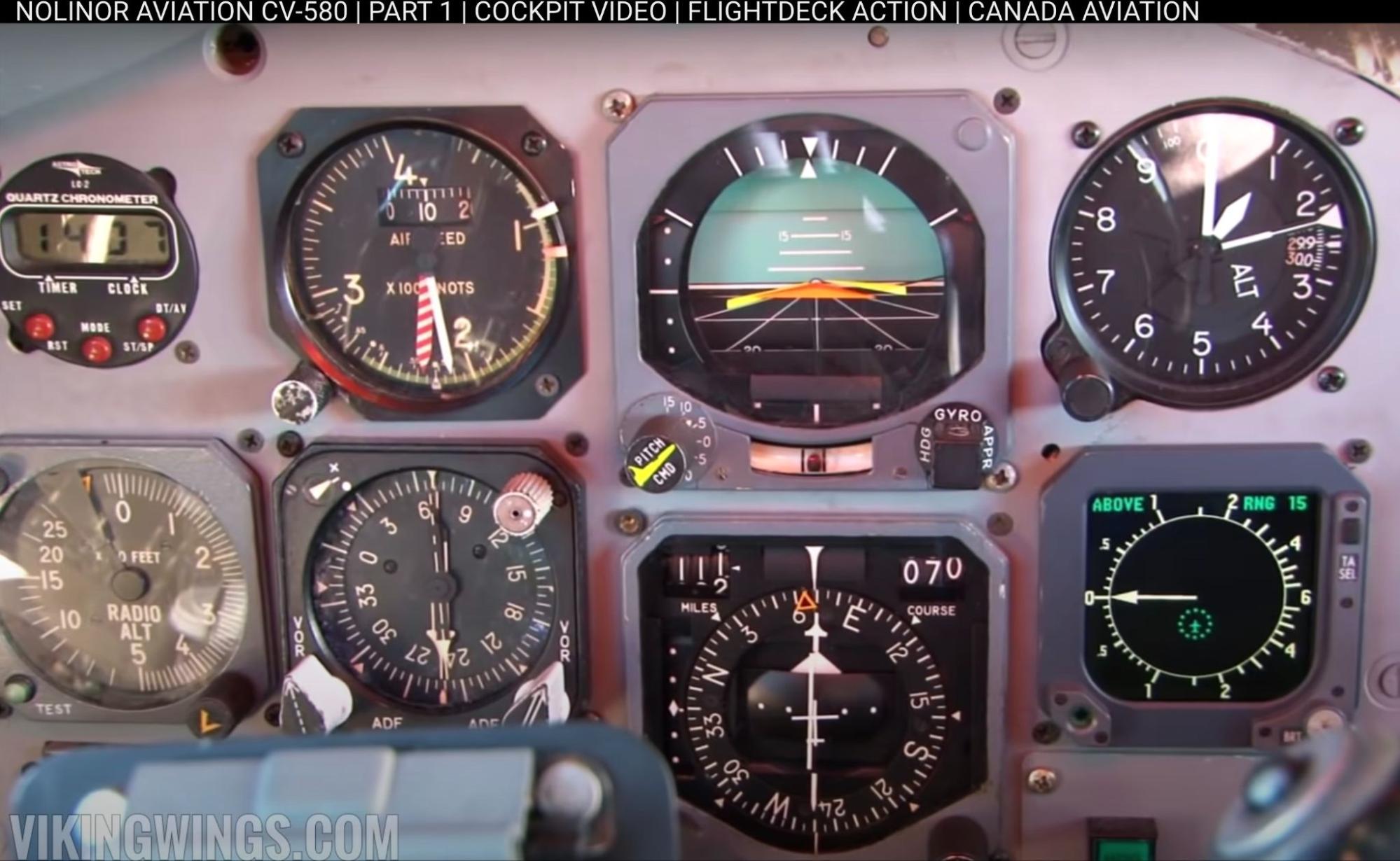
(VikingWings Part 1, 2020, tid 1:15:44)
The airspeed indicator, the artificial horizon, and the altimeter are three of the most essential instruments in the aircraft. Each pilot has these instruments positioned directly in front of them and uses them actively in all phases of flight. At "top of climb," the instruments are used to read when the correct altitude has been reached and when cruise speed has been achieved, so that engine power can be reduced to "cruise power." During cruise flight, the pilots continuously monitor the instruments to detect deviations in heading, altitude, or speed. Even small variations on a pointer can indicate the onset of a serious problem. Pilots are therefore trained to "scan" the instruments regularly, so that faults with the instruments or the aircraft's systems can be detected as early as possible.
In a video, a Nolinor captain demonstrates and explains the procedure when "top of climb" is reached. The speed increases before engine power is reduced slightly, and the aircraft stabilises at cruise speed. In this video, the aircraft ends up with a cruise speed of 212 knots.
(VikingWings Part 1, 2020, tid 1:12:40)
In connection with changing engine settings, there is a need to "trim the aircraft." By adjusting the trim tabs, the aircraft will maintain heading and altitude without the pilot (or the autopilot) needing to apply force to the control surfaces. In another Nolinor video, the captain of a Convair CV-580 demonstrates the entire process from "top of climb" until "cruise power" is set and the aircraft is trimmed. The process of adjusting the engines and trimming the aircraft was completed in under one minute.
(Air-Clips, 2020, tid 1:40:30-1:45:35)
There are several videos showing flights with the Convair CV-580, and one will observe that the indicated airspeed varies with altitude and load weight. What is important to note is that the videos show the pilots using the same procedure at "top of climb": let the aircraft accelerate to cruise speed, and then set "cruise power." Another important observation is that the pointer on the airspeed indicator remains completely steady when the aircraft is at cruise speed.
The exact cruise speed depends on the total weight and altitude. When the engines are set for "cruise power" and the control surfaces are trimmed, the speed will stabilise and remain stable, provided there is no severe turbulence.
LN-PAA's Cruise Speed
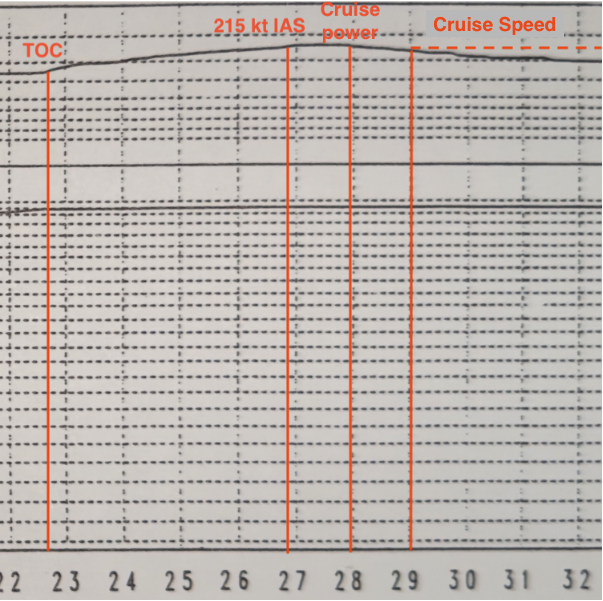
Data from the Flight Data Recorder (FDR) shows that LN-PAA reached its cruise altitude of 22,000 feet (flight level 220) at 22:40 FDR time. After that, the aircraft took approximately 4 minutes to reach a speed of 215 knots. One minute later, a reduction in speed occurs. It is reasonable to assume that the reduction occurred in connection with the engines being set to "cruise power." 215 knots is somewhat higher than what is shown in the videos, which may mean that the crew maintained "climb power" slightly longer than necessary, and that the aircraft therefore accelerated to a few knots above cruise speed.
There is a potential inaccuracy in the Flight Data Recorder system, specified as ±10 knots. (The Accident Report, 1993, p. 35)
Since the exact cruise speed for LN-PAA is not known, the process at "top of climb" must be taken into consideration, in addition to comparison with other similar flights. Given that 215 knots appears to be a slightly high cruise speed, and that a speed reduction occurs relatively shortly after it was achieved, this may indicate that the actual cruise speed was a few knots lower than 215. After a slight speed reduction, LN-PAA would then have had a cruise speed consistent with what is observed in available videos.

In the FDR printout, there are only markings for 200 and 225 knots. Horizontal dashed lines have been added to the FDR printout to clarify the approximate speed after "top of climb."
«When desired altitude is reached, climb power should be maintained until airspeed exceeds anticipated cruise value by approximately 5 knots. (Never exceed VMO). This procedure provides an airspeed "cushion" to allow for aircraft trim adjustments.»
(Pilot's Handbook Convair 580, 1977, side 18-8)
Taking into account what is stated in the aircraft's handbook, as well as the fact that LN-PAA achieved a speed of 215 knots after "top of climb," it is probable that LN-PAA's cruise speed in the FDR data would have been approximately 210 knots. This contradicts the premise of the accident report, which assumes that the aircraft's normal cruise speed on the day of the accident was approximately 200 knots.
The image shows the point for "top of climb" and when the highest speed (215 knots) was achieved. In addition, the point where the crew presumably set "cruise power" is shown, and the dashed line shows 210 knots, which would have been a plausible cruise speed on the accident flight.
Speed Premises
It is difficult to understand how the accident investigation board arrived at the conclusion that 200 knots was normal cruise speed for a Convair CV-580. In connection with the analysis of FDR data, airspeed is highly relevant—even small variations in indicated airspeed can provide important clues as to what has happened.
Interviewed pilots have confirmed that the cruise speed is around 200 knots, depending on load and cruise altitude, and the aircraft's documentation contains calculation diagrams showing cruise speeds in this range. It may therefore be tempting to believe that the accident investigation board used the Flight Data Recorder data as confirmation that the speed was normal during the final minutes, since it apparently was around 200 knots.
If one considers that the speed should have stabilised approximately at the peak of the curve and remained completely steady thereafter, it becomes easier to see that the accident investigation board's premise regarding cruise speed cannot be correct. A stepwise reduction over a relatively long period, followed by a speed with variations large enough to produce deflections on the airspeed indicator, is not consistent with normal cruise speed.
Speed Data from the Flight Data Recorder
The only known speed that can be used to calibrate the speed from the Flight Data Recorder (FDR) is the take-off speed. The FDR recorded when the aircraft began to climb, and this point is used to define where FDR time starts. The take-off speed is pre-calculated based on the total weight of the aircraft.
The Flight Data Recorder recorded approximately 130 knots at the moment of take-off, which is 10–15 knots higher than the expected speed of 110–115 knots.
This provides an indication that the indicated airspeed recorded by the Flight Data Recorder is higher than what was shown on the airspeed indicators in the cockpit. According to the specification for the Fairchild Flight Data Recorder, the accuracy for airspeed is specified as ±10 knots. (The Accident Report, 1993, p. 35)
Expected Speed
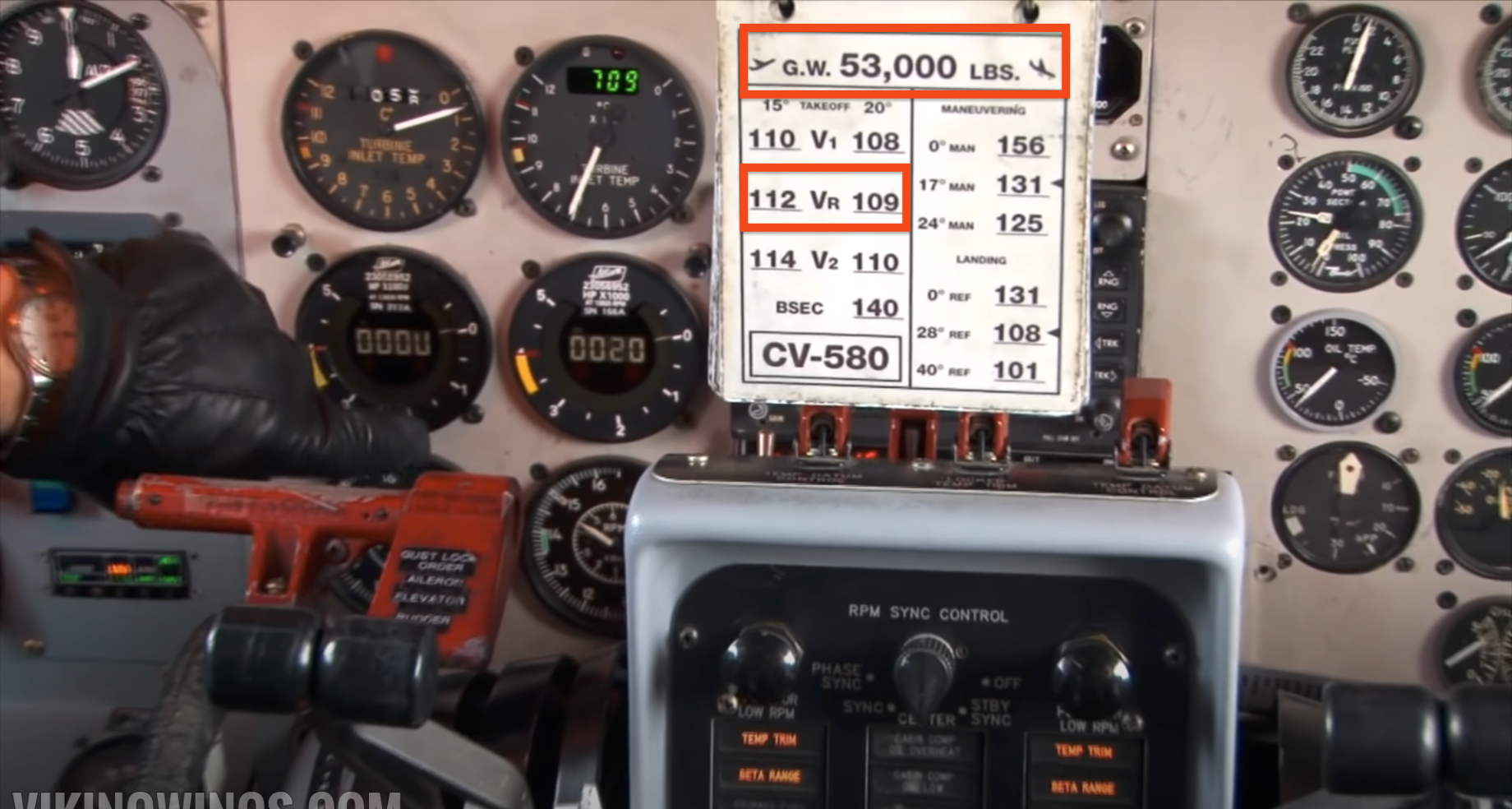
From the VikingWings videos, one can see the take-off speed (VR) for 53,000 pounds and 50,000 pounds respectively. With 20 degrees of flaps, the wing generates more lift than with 15 degrees, which results in a slightly lower take-off speed. The heavier the aircraft, the higher the take-off speed required, as more lift is needed to compensate for the weight.
Take-off speed (rotation speed) for the Convair CV-580 with 15 and 20 degrees of flaps, based on speed reference cards in the VikingWings videos.
Weight (LBS/pund) | 15° flaps | 20° flaps |
50.000 | 110 | 106 |
53.000 | 112 | 109 |
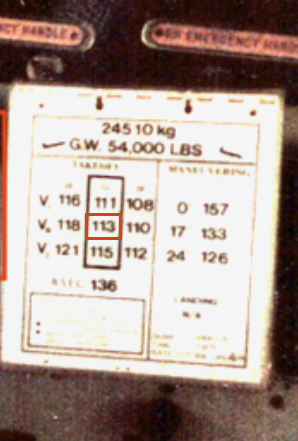
In the weight and balance sheet for LN-PAA, a total weight of 24,768.7 kilograms was calculated. (The Accident Report, 1993, p. 28)
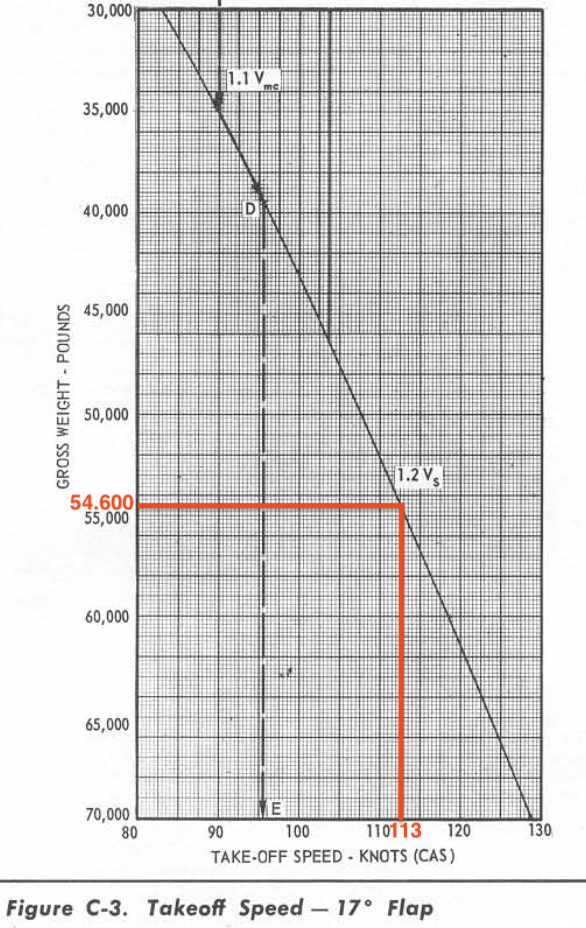
This corresponds to 54,606 pounds, and would likely have resulted in a take-off speed a few knots higher than for 53,000 pounds.
From the take-off speed diagram for the military version of the aircraft, one can see that 17° flaps would have required a take-off speed of 113 knots.
(Handbook YC-131C, 1955, p. 128) |
(VikingWings Part 1, 2020, time 58:17) The image shows the speed reference card for 53,000 pounds. |
(VikingWings Part 1, 2020, time 1:21:01) The image shows the speed reference card for 50,000 pounds. |
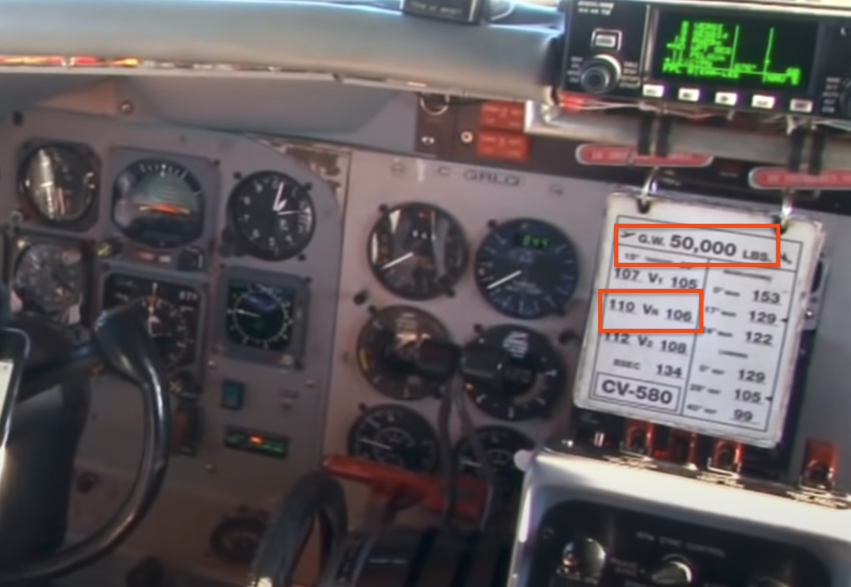
Image of the reference card from LN-PAA, taken on the return trip from Canada in the summer of 1989. |
Recorded Speed
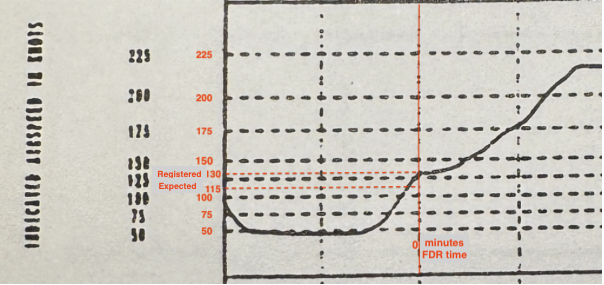
The image shows the first four minutes of speed data recorded by the Flight Data Recorder (FDR). At the moment of take-off (0 minutes FDR time), the expected speed was approximately 115 knots, while the recorded speed appears to be approximately 130 knots.
Missing Calibration Profile for the Flight Data Recorder
The accident investigation board commissioned a report from Accident Investigation & Research (AIR), which includes, among other things, a detailed analysis of the Flight Data Recorder. In this report, the following is stated about the calibration profile:
"The Recorder's actual calibration template was not available for the A.I.R. analysis." (Accident Investigation & Research, 1992, p. 43)
By using a standard profile instead of the calibration profile for the specific Flight Data Recorder, an uncertainty arises in the values that were read. This uncertainty is not discussed in the accident investigation board's report.
The altitude data in the Flight Data Recorder is also not correct. Despite the pilots being assigned 22,000 feet as their altitude, and the aircraft's transponder recording an altitude of 21,900 feet (according to radar data), the reading from the Flight Data Recorder shows 22,500 feet. The aircraft's altimeters, autopilot, transponder, and Flight Data Recorder use the same pitot-static system to record pressure altitude, and there should therefore have been consistent altitude readings between all these components.
The Airspeed of LN-PAA
In order to establish what normal cruise speed was according to the Flight Data Recorder, it is necessary to compare with readings from other flights. In the AIR report, there is a table based on data from multiple flights, where cruise altitude is specified. These data show that the average speed was 212 knots when the aircraft was at cruise altitude (above 20,000 feet). The difference between 200 and 212 knots represents approximately 12% of the kinetic energy, and is in other words significant.
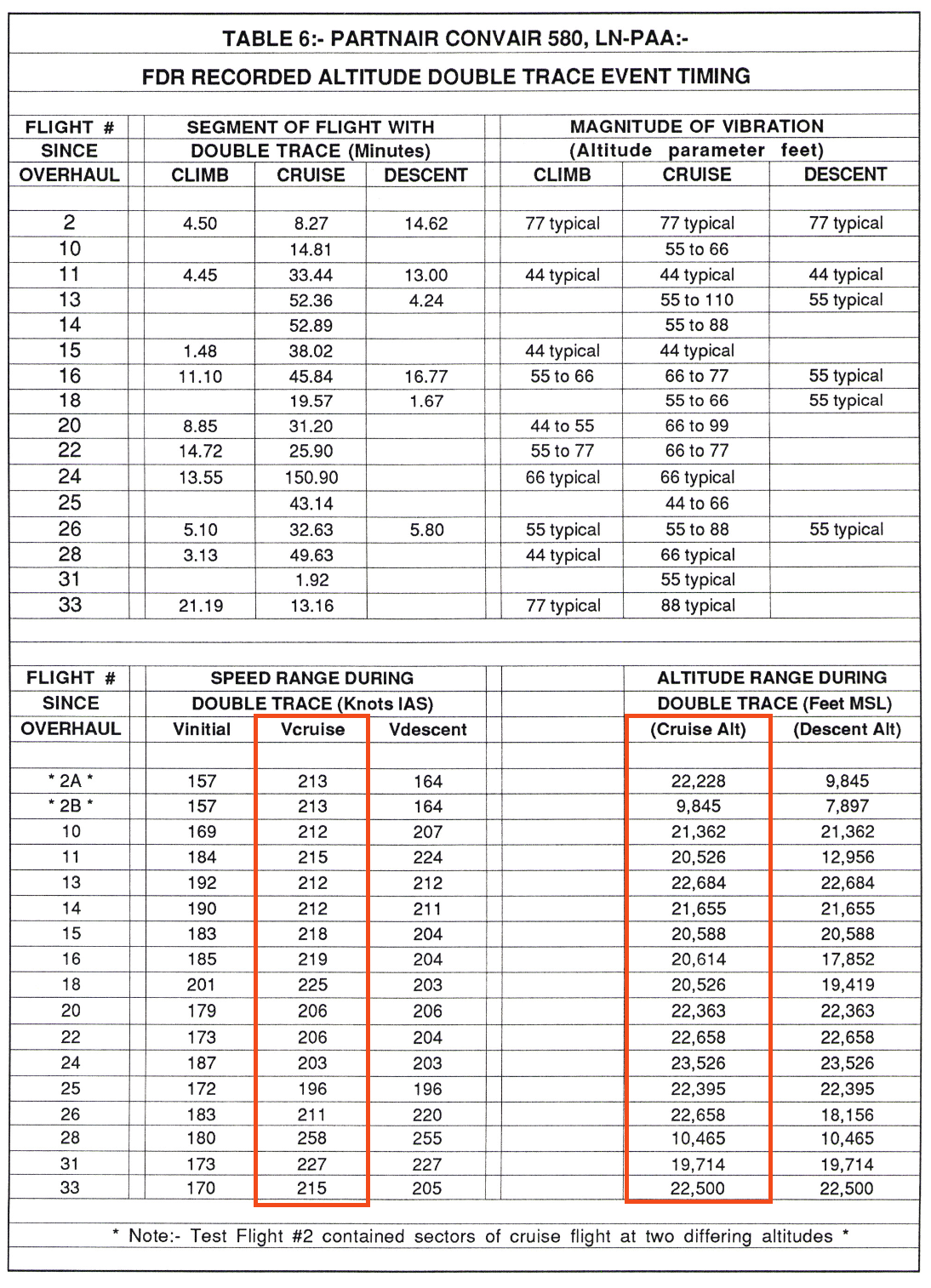
(Accident Investigation & Research, 1992, Table 6)
If one assumes that the Flight Data Recorder recorded 10–15 knots higher indicated airspeed than the actual speed, this means that LN-PAA had 200–205 knots as its highest speed after "top of climb." Thereafter, the speed fell to 185–190 knots for the final minutes of the flight. This is clearly below normal cruise speed for LN-PAA.
It seems unlikely that the accident investigation board attempted to verify the speeds that LN-PAA should have had during the different phases of the flight, and therefore missed essential information about whether the Flight Data Recorder actually recorded the true indicated airspeed. The precision of ±10 knots has not been examined further beyond its listing as a specification in the FDR documentation.
The low precision for speed in the Flight Data Recorder is significant because the accident investigation board's conclusion is partly built on the premise that the aircraft was maintaining normal cruise speed. Although there is some uncertainty regarding the speed, it is important to emphasise that it is the abnormal speed curve that is the most important indication that the aircraft was not at normal cruise speed. The cruise speed should have stabilised close to the highest speed, not decreased by 15 knots over time as LN-PAA's speed did.
Abnormal Speed
After the aircraft reached its highest speed with climb speed, following level-off (top of climb), the crew set the engines to "cruise power," which resulted in a small reduction in speed of a few knots. After the speed stabilised, it should then have remained constant in the subsequent minutes. According to the speed values in the FDR, the speed should have decreased from 215 knots to approximately 210 knots when cruise power was set. Over the next three minutes, the speed decreases to approximately 200 knots. The actual speed, taking into account the correction for FDR misreading, was lower. If we assume a 15-knot correction of the speed, this would mean that after cruise power was set, the aircraft had an actual indicated airspeed of 195 knots. Although this may sound like little, a reduction of 10 knots would be significant considering that energy increases with the square of speed, and the same applies to drag. 10 knots at these speeds means a 10% reduction in engine power, which is significant in this context. (1 + 10/195)² = 1.105 (10%)
Pilots operate in accordance with the company's Standard Operating Procedures (SOP). Given that the costs of the aircraft are linked to the time it is airborne, it is standard practice to fly this aircraft type at maximum permitted continuous engine power, provided there are no other factors that would require a reduction in engine power. In any case, it is not normal to reduce engine power by 10% shortly after normal cruise speed has been achieved, given that nothing unusual had occurred.
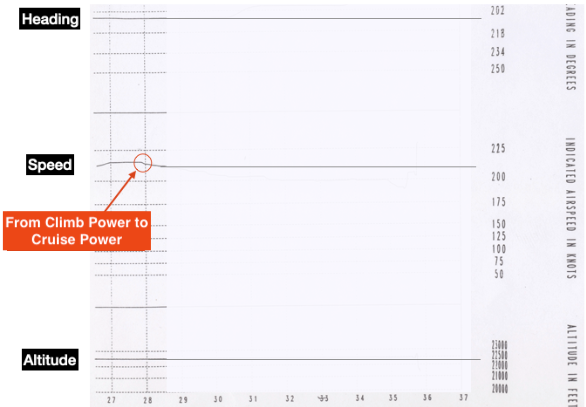
FDR recording of heading, speed, and altitude as it would have been in a normal situation. |
FDR recording of abnormal speed reductions. |
Turbine Inlet Temperature (TIT) Indicator
The TIT indicator shows the temperature of the exhaust gas after the combustion chamber, on its way into the turbine.
In the Convair 580 handbook, the maximum permitted performance values for the engines are specified in °C TIT. It is worth noting that the maximum permitted temperature for "cruise power" is 847 °C. If these limits are exceeded, the engines may be damaged.
«Maximum Continuous: 932° Climb: 895° Cruise: 847°» (Pilot's Handbook Convair 580, 1977, 2-6)
«maximum cruise power of 847°» (Pilot's Handbook Convair 580, 1977, 4-1)
The accident investigation board examined both the analogue and digital components of the TIT instruments. The findings indicated that TIT showed higher values than the maximum permitted temperature of 847 °C, yet the accident investigation board nevertheless concluded that this was a normal temperature for cruise speed.
«Turbine Inlet Temperature (TIT) Indicators from both engines were recovered and examined. The indicators were of electromechanical type, with an approximately 2-metre-long magnetic tape that is positioned in accordance with the temperature indication. The tape is transferred alternately between two spools and remains in the position it held when the power supply to the instrument was cut off. … There was no visible mechanical damage that could cause deviation in the gauge reading. Digital reading gave 853 °C, analogue 850 °C. Of the servo-potentiometer tape, 62 cm was on the drive side and 126 cm on the opposite side. Comparative tests with an undamaged gauge of the same type showed that the distribution of tape between the two spools in the ratio 61/126 corresponded to an indication of 850 °C. This is normal temperature for engine setting at cruise speed." (The Accident Report, 1993, p. 50)
Pilots fine-tune engine settings based on TIT to remain as close to the maximum permitted performance as possible. When the examinations show a 3–6 °C deviation from 847 °C, it is natural to discuss what the cause of this deviation may be. One possible explanation is that the crew had reduced engine power but had not completed the fine-tuning. Another explanation may be that all significant speed changes throughout the sequence of events were caused by changes in engine settings, and that the crew set the throttle levers back to approximate "cruise power" before the power failure occurred. When the temperatures that the accident investigation board read from the instruments do not match normal values for "cruise power," this should have been discussed further—rather than making the erroneous claim that 850 °C is "normal temperature for engine setting at cruise speed."