Navigation
Prior to a flight, a navigation plan is prepared and submitted to the air traffic service. The plan serves as the basis for the route the aircraft is to follow, but changes can be made en route. Air traffic controllers may need to instruct pilots to alter heading and altitude for traffic management purposes, and pilots may request changes to heading and/or altitude if, for example, there is a need to fly around adverse weather.
When a passenger aircraft apparently deviates from its course shortly before an accident, there is reason to examine this deviation more closely. A change in heading should be attributable to one of the following causes:
- The navigation plan
- Instruction from air traffic control
- An approved request from the pilot
- Inattention
- Emergency
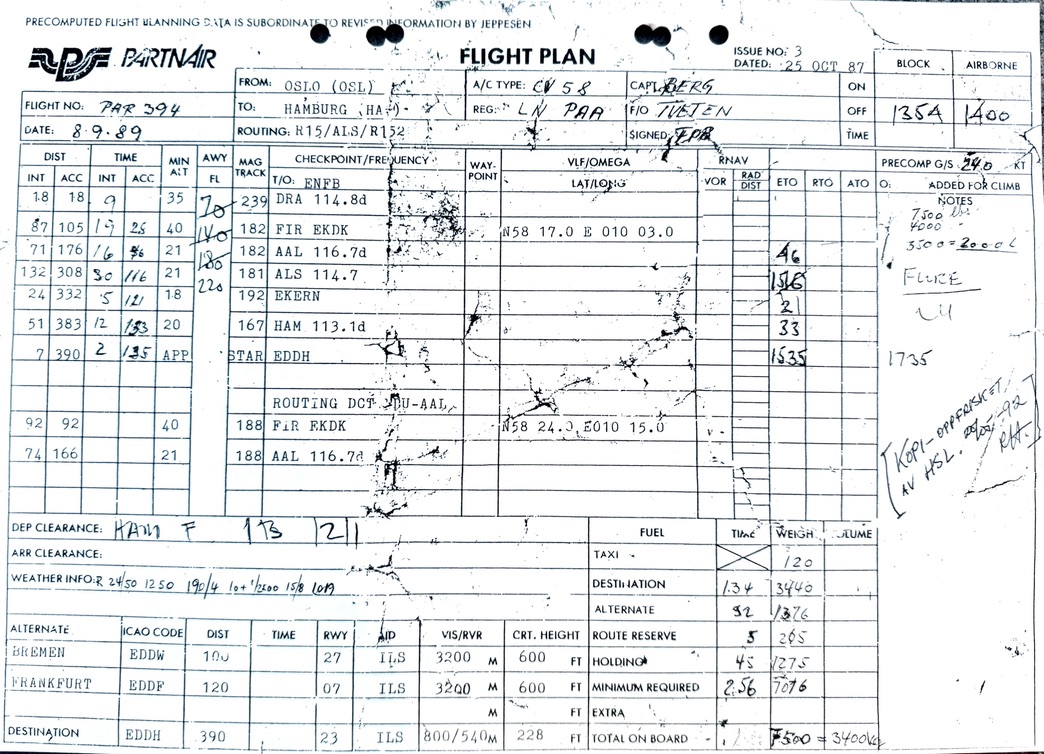
The navigation plan for LN-PAA called for no heading change when the first turn began. No instructions had been issued by the air traffic controller, and the pilots had not requested a change of heading. A pilot who discovers that the aircraft has drifted off course will correct this immediately, but no such correction was made by the crew of LN-PAA. Three left turns were made before the aircraft crashed, with no indication of correction.
When it is not possible to understand the cause of LN-PAA's turns, or to see any indication that the crew attempted to correct the heading deviation, the accident investigation board should have regarded this as an indicator that the situation was outside the normal.
Background
Commercial flights are conducted in accordance with Instrument Flight Rules (IFR). This is a comprehensive regulatory framework in which both pilots and air traffic controllers have clearly defined responsibilities and tasks. In brief, the pilot is responsible for the aircraft and navigation, while the air traffic service is responsible for maintaining separation between aircraft and managing air traffic. An air traffic controller provides both information and instructions to pilots. If a pilot wishes to change heading or altitude, the controller must issue a clearance first. Normally, a controller will attempt to accommodate the pilot's request, provided it does not compromise safety or create problems for others.
The navigation plan for a flight is submitted to the air traffic service by the pilot or the airline. In this way, all controllers along the route receive information about the destination and the route the aircraft will follow. In modern aircraft, the entire route can be programmed into a Flight Management System (FMS), allowing the autopilot to fly the route primarily using GPS. In older aircraft, such as the Convair CV-580, there are no equivalent automation systems, which means the pilots must do more of the work manually.
An autopilot is not necessary for flying, but it is a very effective tool for reducing the pilot's workload. Maintaining correct heading and altitude requires significant attention, especially in turbulent air. When a pilot is "hand-flying" the aircraft, they will have less capacity for other tasks than when the autopilot is engaged.
Partnair 394, Navigation Plan, signed by Captain Finn Petter Berg. |
Heading
The route went from Fornebu via Drammen VOR (radio navigation beacon), Aalborg VOR, and further southward towards Hamburg. The radar track shows that the aircraft followed the coastline southward while climbing towards cruise altitude.
The navigation plan recovered after the accident shows that Finn Petter Berg was the captain (CAPT) and Knut Tveten was the first officer (F/O). The form is signed by Berg (FPB). In the accident report, the accident investigation board assumed that Tveten was the captain, despite this navigation plan documenting the opposite. The captain normally sits in the left seat, and the error may be significant for interpreting who performed which actions in the cockpit. It is worth noting that the accident investigation board had access to this navigation plan, yet failed to identify the role assignment.
«Between 20:50 and 30:30 FDR time, the heading was approximately 208° M.» (The Accident Report, 1993, p. 39)
Most pilots choose to use the autopilot during this phase of the flight, and it is reasonable to assume that LN-PAA was flying with autopilot engaged.
Navigation Premises
The last recording of heading, altitude, and speed was made at approximately 35:45 FDR time, when a power failure occurred in the aircraft.
«At 30:30 FDR time, a heading change of 8.5° to the left was recorded. At 33:40 FDR time, the heading was again changed 5.5° to the left. One minute later, there was a further 5.5° heading change to the left.» (The Accident Report, 1993, p. 39)
Heading (top) and speed (bottom), with red dashed line indicating expected/normal situation. |
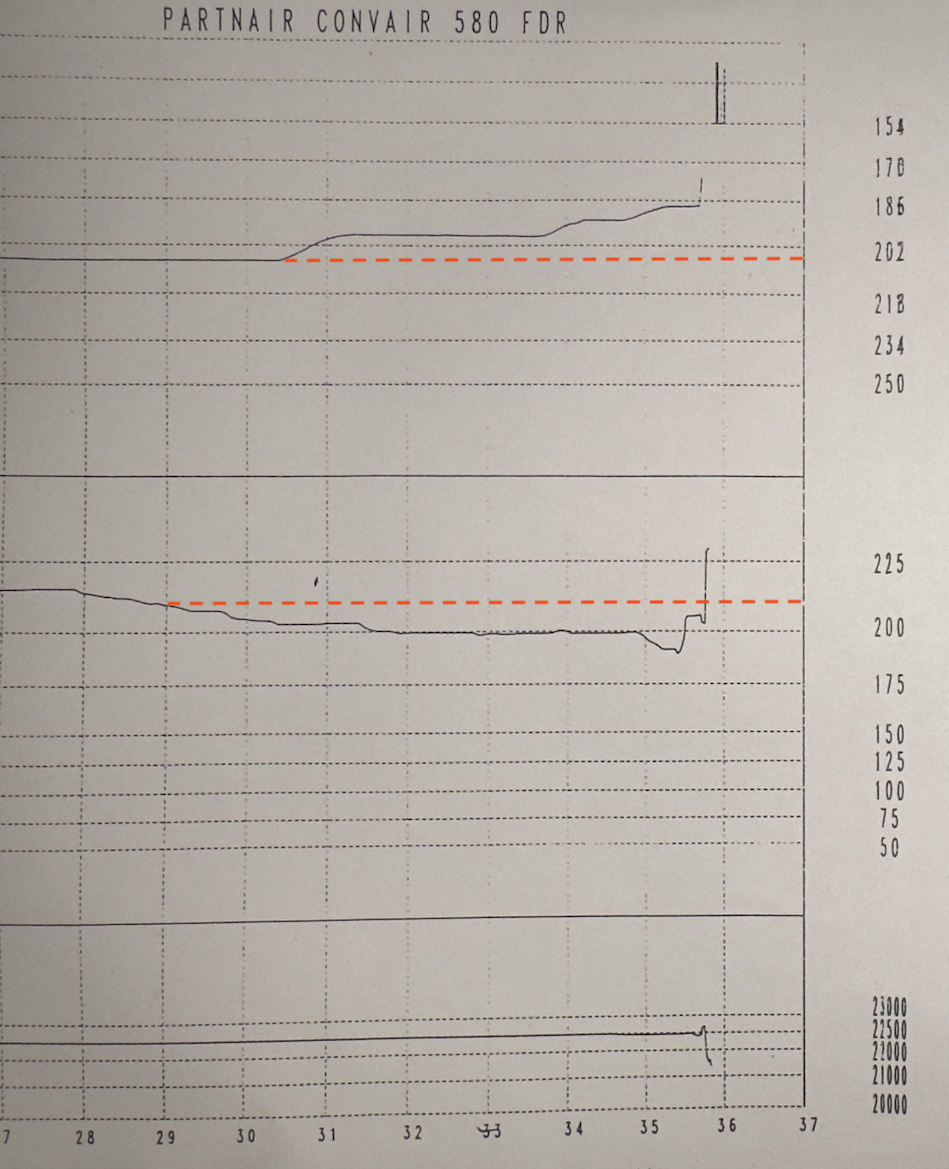
It is worth noting that these "turns" cannot really be characterised as turns, but rather as gradual heading deviations. An autopilot normally turns at a standard rate of 3° per second. The first heading change of 8.5° occurred over approximately 40 seconds, which corresponds to approximately 0.21° per second—less than one-fourteenth of a normal autopilot turn. Had the autopilot been engaged and commanded a heading change, the turn would have been completed in under 3 seconds, not 40. The gradual heading deviation is therefore a strong indication that the autopilot was not engaged when the aircraft began to drift off course.
«The change of direction to the left that occurred at 34:00 FDR time was, in isolation, not alarming, but it appears unmotivated after a period of stable flight parameters. It is, moreover, coincident with a speed change that also appears unmotivated. During the period immediately before 34 minutes after departure (FDR time), where the recorded flight parameters show very stable values, the commission believes the autopilot was engaged. Judging by the recorded values, altitude and heading had been selected as governing parameters.» (The Accident Report, 1993, p. 102)
LN-PAA received no request from air traffic control to change heading, and from a navigational standpoint it is difficult to understand why the crew would make heading changes that neither brought the aircraft back to the planned route nor towards Aalborg VOR. It is difficult to understand why the report does not question these heading changes, when there is apparently no reason for the crew to have chosen to alter the heading. When we additionally know that the aircraft ultimately "rolled" to the left, it seems probable that all three turns were unintentional.
The premise that the heading changes were not alarming because «the recorded flight parameters show very stable values» seems illogical. One cannot conclude that a turn is normal because it has been a while since the aircraft last turned.
Other data must be analysed to assess whether the heading changes were normal or anomalous. The heading changes do not appear to be rooted in navigational decisions. Data from the Flight Data Recorder for speed indicates that the aircraft was not at normal, stable cruise speed. In practice, this means that the only remaining parameter that can be interpreted as normal is the altitude. Altitude alone is not a sufficient basis for concluding that a turn is "not alarming."
«At approximately 35 min FDR time, a new change of direction to the left occurred, coinciding with a marked loss of speed.» (The Accident Report, 1993, p. 102)
«During the period 34 to 36 min FDR time, the vibrations assumed catastrophic dimensions and began to affect the aircraft's directional stability. The oscillations were no longer damped by the structure's rigidity; they became divergent, i.e. the displacement (amplitude) increased with each cycle. … The crew probably knew at this point that something was wrong in the tail, and activated the fire extinguisher for the APU. This caused the fuel supply to the APU to be shut off, but had no influence on the subsequent course of events.» (The Accident Report, 1993, pp. 106–107)
The accident investigation board appears to categorise the first turn as normal, the second as "not alarming, but unmotivated," and that it was only in connection with the final turn to the left that the autopilot was disengaged and the crew knew they had problems with the aircraft.
The pilots were trained to continuously monitor the aircraft's instruments and would in all probability have quickly detected deviations in heading or speed. The accident investigation board's conclusion appears to be built on a hypothesis that the pilots of LN-PAA detected neither deviations in the aircraft's speed nor heading—something that seems highly improbable given that the crew consisted of experienced pilots.