Flight Data Recorder
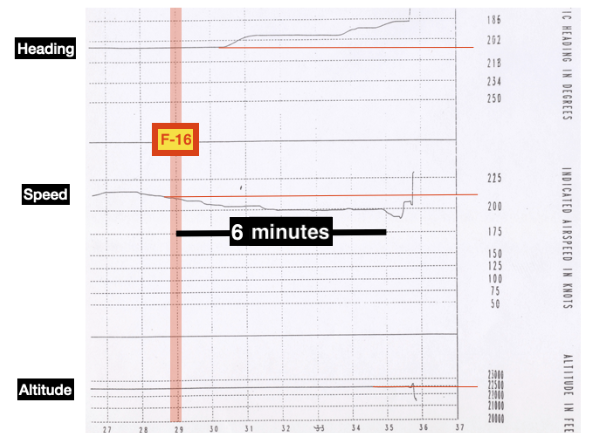
The accident investigation board stated in its report that the F-16 met the Partnair aircraft 9 minutes before the accident, but this is not correct. Nine minutes after the pass, the Partnair aircraft hit the water, but it was quite evident that the situation was critical and that the accident sequence began approximately 6 minutes after the pass. The deviations in expected speed coincide with the pass, which makes it highly probable that there is causality between the F-16 pass and what subsequently occurred.
«The Norwegian fighter jet, which met LN-PAA approximately 9 minutes before the accident, did not participate in the NATO exercise.» (The Accident Report, 1993, 1.17.5.3, p. 84)
6 minutes from the F-16 pass until the situation becomes catastrophic. |
Situational Analysis
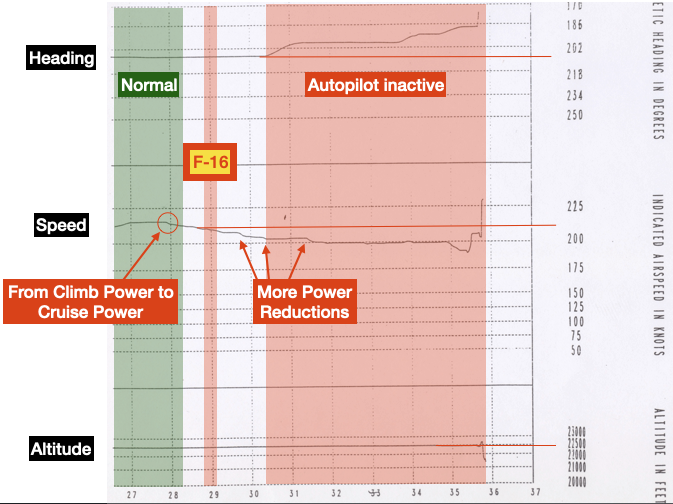
Everything up until the F-16 pass appears, according to the FDR, to be normal. It is only when the F-16 passes that the deviations begin. It starts with stepwise speed reductions, as well as a heading deviation, which cannot have been carried out by the autopilot. There are speed reductions both before and after the first heading deviation.
This is of significant importance, as it coincides with a troubleshooting process where one change is made at a time—reduction in speed and deactivation of autopilot—and the effect is observed. This suggests a systematic troubleshooting process, not coincidence.
FDR analysis of emergency situation. |
Hypothesis Regarding the Sequence of Events
The pass by the F-16 happens so fast, and directly from ahead, that the crew of the Partnair aircraft in practice had no opportunity to see the F-16. They would certainly have heard the supersonic shock wave striking the fuselage, and noticed that something happened to the aircraft. Physical damage to the rudder's trim tab could have produced vibrations and a tendency towards left yaw, meaning the aircraft rotates slightly to the left. The autopilot would have immediately corrected the heading deviation using the ailerons, but the pilots would have noticed if the aircraft was flying uncoordinated (at a sideslip), in addition to the autopilot signalling that it was applying corrective input.
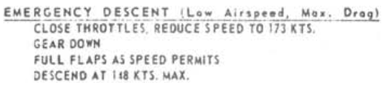
There is no doubt that the crew detected that something was wrong, but they cannot have understood what kind of damage had occurred or how serious it was. Having climbed at high engine power and then levelled off and adjusted the engines to cruise power, it is not logical that structural damage to the aircraft would suddenly occur. A far more probable scenario would be if a bang, vibrations, and yaw were the result of an engine-related problem. Had the pilots feared structural damage to the aircraft, they would have reacted entirely differently. They would have immediately reduced speed, initiated an "emergency descent," and notified air traffic control.
Checklist for "Emergency Descent (Low Airspeed, Max Drag)." |
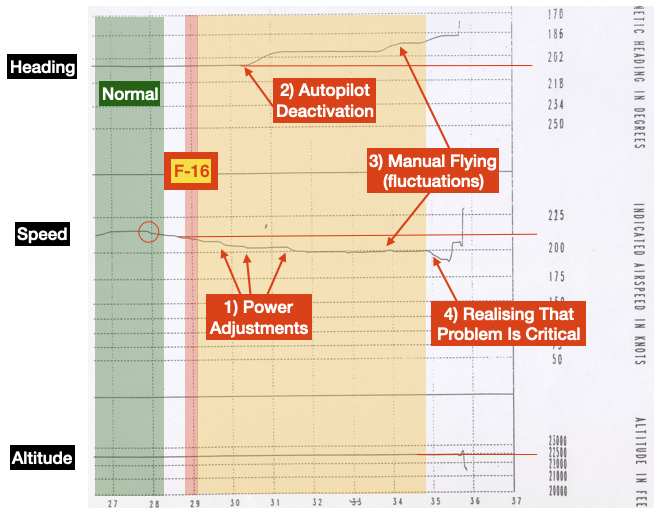
Towards the end of the sequence of events, at 35 minutes FDR time, a more pronounced reduction in speed is observed before it rises again. A possible interpretation of this is that it was only then that the pilots realised how serious the situation was. Something causes them to increase engine power significantly again, as within a few seconds the speed increases by approximately 15 knots. It appears that this speed increase triggered the actual accident sequence, as the aircraft rolled and entered a dive a few seconds later. The crew never managed to regain control of the aircraft. It dived towards the sea, speed increased, and eventually flutter developed in the control surfaces until they ultimately disintegrated. This sealed the fate of Partnair 394.
Flight Data Recorder analysis, where the yellow area indicates what the accident investigation board interpreted as normal. |
The Accident Investigation Board's Interpretation of the Flight Data Recorder
«The change of direction to the left that occurred at 34:00 FDR time was, in isolation, not alarming, but it appears unmotivated after a period of stable flight parameters. It is, moreover, coincident with a speed change that also appears unmotivated. During the period immediately before 34 minutes after departure (FDR time), where the recorded flight parameters show very stable values, the commission believes the autopilot was engaged. Judging by the recorded values, altitude and heading had been selected as governing parameters.
The variations in altitude recorded during this period are within normal variations. In conjunction with radar data, the altitude recordings during this period contribute to aligning the various time measurements that have been made.
At approximately 35 min FDR time, a new change of direction to the left occurred, coinciding with a marked loss of speed. The indicated speed increase that began at approximately 35:45 FDR time is of a magnitude that is not real. This means that the measurement system for the FDR was at this point affected by error sources that are not present during normal operation. A relevant error source is abnormal flow conditions at the aircraft's intakes for static air pressure (static ports). Uncoordinated yaw and rapid pitch changes will produce such conditions, and may result in erroneous indications of speed and altitude.
Immediately before the FDR stopped, the heading parameter first showed approximately 3 seconds of turn to the right, then transitioned directly into a change of heading to the left in the order of 500° per minute. To understand the significance of this recording, the commission has relied on information from the manufacturer of this type of FDR. In four previous accident cases where corresponding types of recordings have occurred, there were either eyewitnesses or technical findings that confirmed the aircraft's movements. The eyewitnesses reported that the aircraft rolled at the time the FDR made the recordings in question.» (The Accident Report, 1993, p. 102)
It is very difficult to understand how the accident investigation board analyses the Flight Data Recorder in this manner. Even if they did not know that the speed values were misread—despite the fact that a 500-foot error in altitude should have provided an indication that there could also be errors in speed—they should in any case have seen that the speed graph itself did not look right.
The speed was normal up until just after cruise power was set, but then it began to deviate. There is nothing unique about this aircraft type in this regard: it is entirely normal for aircraft that speed decreases slightly after cruise power is set, over the course of a few seconds, and that the speed then becomes approximately constant.
What the Flight Data Recorder shows is that an emergency arose shortly after the pass by the F-16. The accident report gives the impression that it was entirely out of the question that the F-16 could have had anything to do with the matter.