Shock Waves
NASA Experiment
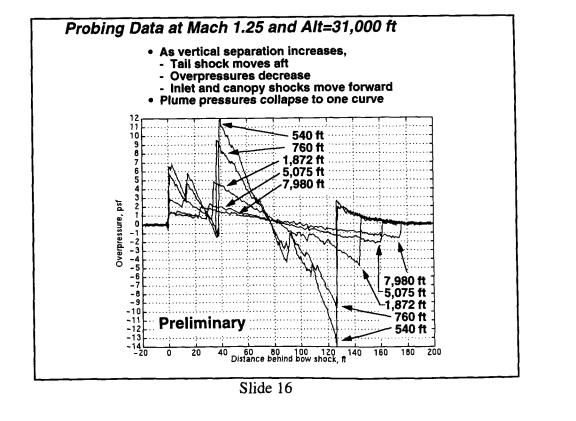
In 1995, NASA published a document describing experiments with shock waves from a supersonic aircraft. They used an SR-71 (Blackbird) as the source of the shock wave, and had an F-16 fly just below (in the same direction) to take measurements of the supersonic shock wave.
«When the F-16XL aircraft probed within 1000 ft of the SR-71 aircraft, its pilot had several indications of crossing the shock waves. These indications include feeling the pressure changes within the cockpit, being slightly jostled by the shock waves, and hearing the SR-71 engines when aft of the tail shock. When probings were conducted at vertical separations greater than about 1000 ft, the pilot was unaware when the shock waves were penetrated.» (NASA, 1995, p. 5)
The measurements show that there is a very large difference in the pressure wave at 540 feet and 1,872 feet of separation respectively. (NASA, 1995, slide 16)
Flygtekniska Försöksanstalten (FFA)
Ingemar A. Lind wrote in his report on the study of this issue concerning a close pass by an F-16 at supersonic speed:
«An experience from the study in Appendix 2 is that the transient load on the elevator due to the shock wave is quite high. For illustration purposes, it can be said to correspond to a sharp blow against the elevator's structure. A rough estimate points to a force of 8,000 N in the typical case.» (Lind, 1999, p. 45)
National Aerospace Laboratory (NLR)
The Ministry of Defence engaged NLR to assess whether a Convair CV-580 could be damaged in connection with a pass at 2,000 feet of separation. In connection with the calculations of whether the vertical fin could be set in motion by the shock wave, the following calculation is described:
«The area of the CV-580's vertical stabiliser is estimated to be equal to 107.48 sq ft (9.99 m²)¹ with which for the peak excitation force is found 2×150×9.99 = 2997 N.» (National Aerospace Laboratory, 2003, p. 27)
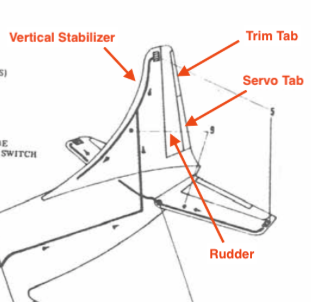
What is worth noting is that the entire vertical fin does not need to move for the control surface to be set in motion. The rudder consists of the rudder surface itself, as well as a smaller servo tab and a trim tab. Damage to the servo tab or trim tab can have catastrophic consequences even without the vertical stabiliser itself being damaged.
The NLR report takes CAR Part 4b as its starting point for calculating the loads that the various parts of the aircraft are designed to withstand. NLR does not, however, discuss what the individual control surfaces are designed to withstand, and has consequently not focused on the trim tabs either.
«Trimming tabs shall be designed to withstand loads arising from all likely combinations of tab setting, primary control position, and airplane speed, obtainable without exceeding the flight load conditions prescribed for the airplane as whole, when the effect of the tab is being opposed by pilot effort loads up to those specified in §4b.220 (a).» (Civil Air Regulations Part 4b, 1953, p. 14)
Pressure Calculation
The NLR report assumes a pressure of 150 N/m², but this is based on 2,000 feet of vertical separation and a horizontal separation of 0.5 nautical miles.
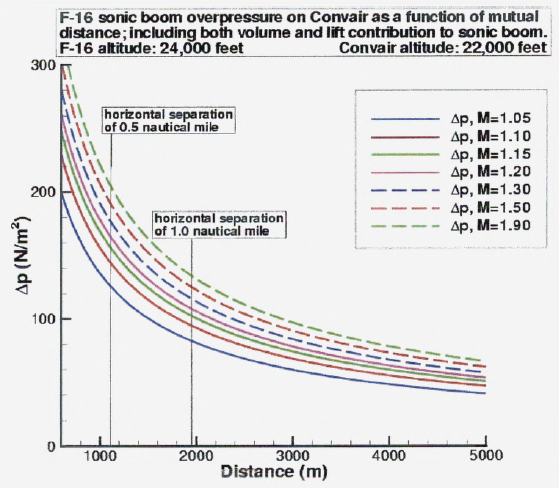
«Fig. 10 shows that, for the second stipulated Mach number of 1.1 and a horizontal separation of 0.5 nautical miles, the overpressure is in the order of 150 N/m². If Fig. 10, influences of Mach number and mutual distance variations are also shown on the sonic boom overpressure.» (National Aerospace Laboratory, 2003, p. 10)
«Overpressures produced by aircrafts flying supersonic at altitudes of less than 100 feet, creating between 20 and 144 psf (957.6 to 6,894.8 N/m2.) overpressure, have been experienced by humans without injury.» (National Aerospace Laboratory, 2003, p. 9)
The fact that humans have not been injured by a shock wave during a close pass does not mean that the hinges of a trim tab cannot be damaged by a corresponding shock wave. The entire conclusion of the NLR report is based on the premise that the vertical separation was 2,000 feet at the point of passing.
The figure shows graphs based on values that do not follow the inverse-square law. This is likely because a fixed vertical separation of 2,000 feet has been assumed, and the x-axis only shows horizontal distance. At 0 metres of horizontal separation, the pressure change from the shock wave, according to the graph, would be 200 N/m², and the absolute separation would be 2,000 feet.
By applying the inverse-square law, at 100 feet of separation—which is 1/20 of 2,000 feet—the pressure change would be 20² = 400 times greater: 200 N/m² × 400 = 80,000 N/m².
Conclusion
The NLR report focuses on three areas: aerodynamics, structures, and flight safety. The aerodynamic calculations are based on the premise that the vertical separation was 2,000 feet. The assessment of the various structural components is based on a pressure change of 150 N/m². Reference is made to nine close passes between fighter jets and civilian aircraft, where apparently no damage occurred to the aircraft. It is not clearly stated which of these close passes occurred at supersonic speed.
«As a result of the study in the three research areas as mentioned above, it is concluded by the multi-disciplinary team of NLR experts that the probability of the RNAF F-16 causing any damage to the Convair CV-580 is extremely small and can be excluded.» (National Aerospace Laboratory, 2003, p. 33)
By focusing solely on the breaking strength of the vertical fin, the NLR experts have overlooked the possibility that the trim tab and/or the servo tab were damaged in connection with the close pass. If the close passes referenced in the report were conducted at subsonic speed, this anecdotal evidence will not be relevant to a potential pass at supersonic speed.
If the premise of a vertical separation of 2,000 feet is false, the calculations in the NLR report are incorrect. It is unlikely that NLR would have reached the same conclusion had the starting point been a close pass with only a few hundred feet of separation at supersonic speed.
Near-Accident
Although there are no known accidents caused by a pass by another aircraft without physical contact, there have been many accidents and near-accidents related to problems with aircraft control surfaces. The Canadian accident investigation board investigated an incident involving a King Air where the control mechanism of the aircraft's rudder trim came loose. In this incident, it started with the crew noticing a slight vibration and a shallow turn. This is an example of how even damage to a trim tab can have major consequences for the aircraft.
«After approximately one hour of flight, while in level cruise at 11 500 feet asl, the crew experienced a slight vibration and a shallow uncommanded right turn. The aircraft was returned to level flight, the autopilot was selected off and a cockpit check was completed when another uncommanded but steeper turn to the right developed. The aircraft was once again returned to level flight and, as the vibration was continuing, a decision was made to land in North Bay due to its close proximity. During the descent, at approximately 8 500 feet asl, a severe vibration developed which violently shook the aircraft and rapidly moved the rudder and ailerons causing the hands and feet of the pilot flying to be displaced from the control wheel and rudder pedals. After approximately 30 to 45 seconds, the vibration stopped and control was regained. The descent was then continued at 140 knots, as the aircraft seemed controllable at this speed. However, to maintain coordinated flight, the crew had to hold approximately 2/3 left rudder. The remainder of the descent, approach and landing were uneventful and the aircraft landed safely. No injuries occurred. A maintenance recovery team was dispatched and examined the aircraft. They determined that the hardware connecting the rudder trim actuator push/pull rod to the rudder trim horn was missing. After replacement of the missing hardware and a free play check, the aircraft was ferried to Ottawa. The aircraft was returned to service after a severe turbulence check and non-destructive testing (NDT) of fittings in the empennage and wings.» (Transportation Safety Board of Canada, 1997)
Discussion
That a fighter jet at supersonic speed should be able to tear apart a passing passenger aircraft seems highly improbable. At a separation of 2,000 feet, the pressure wave from a supersonic pass would likely have limited ability to cause physical damage to an aircraft, although it would be audible inside the opposing aircraft.
After the accident report was published, information has emerged about radio communication between air traffic control and the F-16 pilot, as well as radar data, indicating that the F-16 passed LN-PAA at very close range. If this is the case, it should be reassessed whether a supersonic pass can be excluded as a cause, given that the separation between LN-PAA and the F-16 was much less than 2,000 feet.
In accordance with the inverse-square law, the energy in the shock wave increases dramatically at reduced distance:
Separation | Factor vs. 2,000 feet |
500 fot | 16× |
250 fot | 64× |
125 fot | 256× |
To illustrate the same principle: standing 10 metres from an explosion, one receives only 1% of the energy compared with standing 1 metre away. Standing 20 metres away, the energy is reduced to 0.25%. For both explosions and supersonic shock waves, it is the change in distance that produces the greatest effect.
(Accident Investigation & Research, 1992, Figure 3) Flight tab (5) and Trim tab (6) |
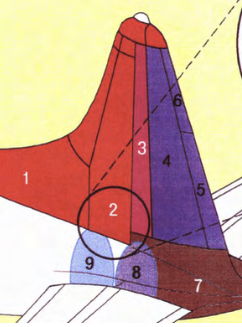
According to Figure 3 in the accident report, the rudder is composed of the "tail rudder," "flight tab," and "trim tab." The gap between the vertical fin and the rudder is covered by "shroud doors." Together, these components constitute a significant portion of the area of the vertical structure, and are therefore exposed to a shock wave from a supersonic aircraft passing alongside the aircraft. Damage to one or more of the rudder components will alter the aerodynamic characteristics, resulting in the aircraft beginning to turn without input from the crew. At high speed, the tail structure is subjected to large aerodynamic forces. Structural damage would be able to develop and worsen the situation rapidly. In other words, even minor damage to the elevator or rudder can have catastrophic consequences.
The accident investigation board has devoted a large portion of the report to substantiating a hypothesis that the cause of the accident was vibrations in the aircraft's tail, which over time developed to catastrophic levels. This hypothesis is built on several sub-hypotheses with varying degrees of certainty. Up until 34 minutes FDR time, the accident investigation board considers that the pilots perceived the flight as normal, and discusses data from the Flight Data Recorder to a limited extent. The accident investigation board also refrained from speculating about what happened after the Flight Data Recorder ceased to record data. In practice, the accident investigation board has thus only defined the last two minutes of the FDR recording as an indication that something was abnormal.
The accident investigation board devotes approximately 10 pages (98–108) to providing an extremely detailed description of the damage that occurred, based on technical findings, and why the damage occurred. It may appear as though the accident investigation board concluded early on that "counterfeit parts" probably triggered the sequence of events, and subsequently explained all the technical findings in a manner that supports this hypothesis.
That vibrations developed over a long period and became so severe that the aircraft's tail section collapsed, without the crew detecting it, seems extremely improbable. The accident investigation board's hypothesis is that when the crew realised they were about to lose control of the aircraft, events unfolded so rapidly that they did not have time to react by pulling the throttle levers to idle.
«At approximately 35 min FDR time, a new change of direction to the left occurred, coinciding with a marked loss of speed. The indicated speed increase that began at approximately 35:45 FDR time is of a magnitude that is not real.» (The Accident Report, 1993, p. 102)
The FDR data and the description in the report indicate that approximately one minute elapsed from the final turn and the marked speed loss until the crew lost control. This is more than enough time to make changes with the throttle levers. It is entirely possible that the final speed reduction was caused by the crew attempting to reduce speed without it improving the situation, and that they subsequently increased engine power again. By concluding early on that the aircraft was maintaining normal cruise speed and that the engine settings were set to "cruise power," the accident investigation board has precluded any further interpretation of the airspeed as recorded by the Flight Data Recorder.
The pass occurred just under 6 minutes before the final, catastrophic accident sequence began. The report states that the F-16 passed approximately 9 minutes before, but this is not correct.
Despite an F-16 passing close to LN-PAA shortly before the accident sequence began, the accident investigation board has not discussed this further. Without interpreting the speed data from the Flight Data Recorder, it would be difficult to see the correlation between the F-16 pass and the point at which LN-PAA's airspeed dropped below normal cruise speed.
A hypothesis that damage occurred to the rudder during the F-16 pass, and that this damage developed to a catastrophic level over the course of 6 minutes of flight, fits better with radar and FDR data than the accident investigation board's hypothesis that vibrations caused by counterfeit parts triggered the accident.