Background
Aircraft share certain similarities with ships, and many terms in aviation are borrowed from maritime navigation. Speed is measured in knots and distance is given in nautical miles. The aircraft is equipped with control surfaces, propellers, navigation lights, and navigation instruments. The airspeed indicator measures speed through the air mass, in the same way that a ship's speed log shows speed through the water. A ship stays afloat without expending energy, whereas an aircraft must move through the air mass to generate lift. Both aerodynamic lift and drag increase with the square of the speed—the higher the speed, the more energy is required to propel the aircraft forward.
Aviation has an extensive regulatory framework, and all parties have their rules and procedures to adhere to. Much of the regulation relates to safety and efficient traffic management. Both air traffic controllers and pilots are regularly evaluated to maintain their certificates. Although both aircraft and regulations are in continuous evolution, most things remain the same today as they were in 1989. Pilots and air traffic controllers still speak the same phraseology on radio, radio navigation equipment is still in use, and the Convair CV-580 still operates in commercial service. This means that with today's knowledge and information sources, it is entirely possible to review an accident that occurred far back in time.
Most components in an aircraft have redundancy, so that the loss of one component does not become critical. All critical instruments exist in duplicate, and the instruments also have partially overlapping functions. This makes it possible to detect instrument errors by cross-checking the instruments.
When studying an accident in retrospect, one must use all available information and cross-check it against other sources. If, for example, one does not have access to cockpit audio recordings or radio communications, one must attempt to use other information sources to understand what has happened.
In connection with the Partnair accident, the Cockpit Voice Recorder (CVR) did not function, which makes it difficult to know what the pilots were thinking and doing. By studying data from radar and the Flight Data Recorder (FDR), and combining this with logic and knowledge of how pilots are trained, it is nevertheless possible to form a picture of what the sequence of events may have been.
The Flight Data Recorder (FDR) is one of the "black boxes" that is sent for analysis after being recovered from the accident site. The FDR data has a time reference based on the number of minutes since take-off, and is referred to as "FDR time."
Group Polarisation
«Group polarisation denotes the phenomenon whereby members of a group often end up with more extreme viewpoints and make more extreme choices than they would have made individually.
If the individuals in a group have a tendency to make high-risk choices, the group will, according to this principle, make even riskier choices. If the individuals in the group are, however, reserved regarding a decision, they tend to become more reserved after discussion among themselves. The polarisation can thus go in both directions.
The term was first used by social psychologists Serge Moscovici and Marisa Zavalloni in the late 1960s. Earlier, James Stoner had used the term 'risky shift' to describe the phenomenon that a group's decision may be riskier than the average of the group's individual members would suggest. Moscovici and Zavalloni found that attitudes generally become more extreme within groups.» (Svartdal, 2021)
In this case, two aircraft are involved, and both had a larger crew in the cockpit than normal. The F-16 was a trainer version with two pilots, in what is fundamentally a single-seat fighter jet. The "risky shift" principle may help explain why a crew of two carried out a close-pass stunt that they as individuals might not have performed.
For the Partnair aircraft, the same principle may have influenced the decision-making process. There was, in fact, a mechanic in the cockpit together with the two pilots. Having a mechanic present would naturally influence the decision-making process during troubleshooting, especially when the problem might be related to engines and propellers. With three people discussing, it may take longer to reach a decision, and it may also influence whether one chooses to err on the side of caution and aborts the flight, or continues in order to evaluate further.
Basic Fighter Maneuvers (BFM)
One of the primary tasks of a fighter jet is to be able to defeat other fighter jets. To do this, the pilots must be well trained in manoeuvring the fighter jet to get into position to shoot down the adversary. This type of air combat is called a "dogfight."
«Basic fighter maneuvers (BFMs) are the building blocks of fighter tactics. They may be classified as primary maneuvers, which can be performed without regard to an adversary (e.g., accelerations, climbs, turns), and relative maneuvers, which must be described or performed in relation to another aircraft. The physics and techniques involved in most primary maneuvers are discussed in the Appendix and therefore are not covered here. No guts, no glory. If you are going to shoot him down, you have to get in there and mix it up with him. Major Frederick C. "Boots" Blesse, USAF 10 Victories, Korean Conflict» (Shaw, 1985, side 62)
"The merge" is the point where two fighter jets meet and the dogfight can begin. When two fighters fly towards each other, they will in practice fly head-on and pass at close range.
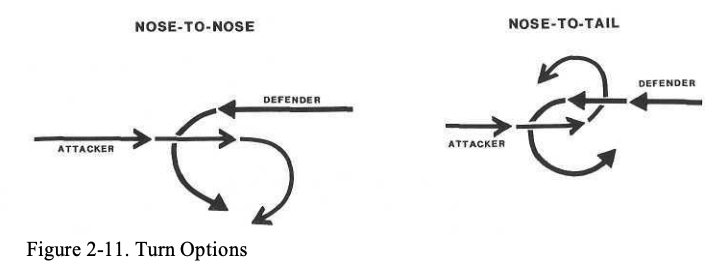
«Nose-to-nose and nose-to-tail turns are two options of fighters meeting in forward-quarter passes. Figure 2-11 graphically defines these maneuvers. As can be seen from this illustration, the names are fairly descriptive. In the first case, one fighter turns left, across the tail of its opponent, while the other turns right, away from its adversary, so that the two fighters again approach in a nose-to-nose fashion. In the second, each pilot chooses to cross the other's tail, resulting in a nose-to-tail relationship. In choosing the nose-to-nose turn, one pilot turns away from his opponent at the pass.» (Shaw, 1985, side 77–78)
Physics
Although aviation has an extensive body of regulations, it is the physical laws that are absolute and that all flight must conform to. The aim of this section is to provide background information on physics topics relevant to the investigation of the Partnair accident.
Shock Waves
Aircraft are designed to withstand very large forces, particularly with regard to severe turbulence. When an aircraft moves through an air mass with varying wind strength and direction, the lift on the wings will vary. Changes in lift result in "bumps" and "shaking" in the aircraft. To reduce the effects of turbulence, speed must be reduced.
Turbulence has been known to aircraft designers since the dawn of aviation, but the effects of supersonic speed were only experienced after Chuck Yeager became the first to break the sound barrier in October 1947. In the mid-1950s, the first fighter jets capable of flying faster than the speed of sound arrived. The Convair CV-240 flew for the first time in 1947, and a further developed version (CV-340) appeared in 1951. The Convair CV-580 is a CV-340 that was converted from piston engines to turboprops. (Convair CV-240 Family, Wikipedia)
Any design principles that make aircraft structures better protected against the effects of supersonic shock waves were most likely not known to the designers of the Convair CV-240, CV-340, and CV-580. The aircraft type was designed before supersonic-capable aircraft existed, and there was therefore little knowledge of shock waves from supersonic flight.
The energy in shock waves diminishes rapidly with distance. A small explosion, for instance, may be relatively harmless at a distance of several metres but can be lethal at close range. In the same way, a supersonic shock wave may have entirely different consequences if the source is close than if it is further away.
«Unlike solitons (another kind of nonlinear wave), the energy and speed of a shock wave alone dissipates relatively quickly with distance. When a shock wave passes through matter, energy is preserved but entropy increases. This change in the matter's properties manifests itself as a decrease in the energy which can be extracted as work, and as a drag force on supersonic objects; shock waves are strongly irreversible processes.» (Shock Wave, Wikipedia)
At a distance, an aircraft breaking the sound barrier sounds like rumbling thunder. At close range, however, it sounds like a double crack of a whip.
«There is a rise in pressure at the nose, decreasing steadily to a negative pressure at the tail, followed by a sudden return to normal pressure after the object passes. This "overpressure profile" is known as an N-wave because of its shape. The "boom" is experienced when there is a sudden change in pressure; therefore, an N-wave causes two booms – one when the initial pressure rises reaches an observer, and another when the pressure returns to normal. This leads to a distinctive "double boom" from a supersonic aircraft. … Duration of sonic boom is brief; less than a second, 100 milliseconds (0.1 second) for most fighter-sized aircraft and 500 milliseconds for the space shuttle or Concorde jetliner. The intensity and width of a sonic boom path depend on the physical characteristics of the aircraft and how it is operated.» (Sonic Boom, Wikipedia)
Inverse-Square Law
In this case, physical laws related to distance and energy transfer are absolutely essential: energy in the form of waves—in light, water, and air—diminishes with distance. This is because a given amount of energy is spread over an ever-larger area. In practice, this means that the closer one is to the energy source, the greater the amount of energy one receives. Halving the distance quadruples the energy.
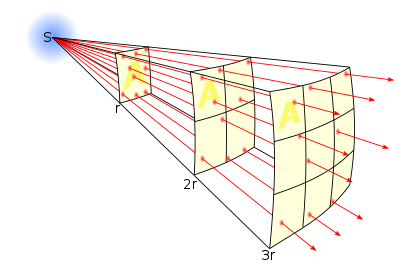
«In science, an inverse-square law is any scientific law stating that the observed "intensity" of a specified physical quantity is inversely proportional to the square of the distance from the source of that physical quantity.» (Inverse-Square Law, Wikipedia)
This is crucial with regard to how close the F-16 was. If one assumes that the F-16 passed 2,000 feet away, the energy from a shock wave is only one quarter of what it is at 1,000 feet. Therefore, one cannot argue that a close pass at 2,000 feet is harmless and from this conclude that the F-16 could not have damaged the Partnair aircraft even if it flew closer. A pass with 100 feet of separation would deliver a transferred energy 400 times greater than a pass with 2,000 feet of separation.
Flutter
Flutter—undamped oscillations of the control surfaces—creates severe vibrations throughout the entire aircraft. It seems inconceivable that flutter would have arisen gradually on its own, without the pilots detecting it. Given that there is no damage to the aircraft's structure, flutter will not occur unless the speed is far above the aircraft's certified maximum speed.
«Control surfaces are designed so that flutter can never occur during normal operation. If the speed is increased beyond 'the critical flutter speed,' the control surface by definition begins to oscillate 'on its own.'» (Lind, 1999, p. 31)
To reach the speed necessary for flutter to develop in the control surfaces, the aircraft must be in a dive. If the Partnair aircraft entered an uncontrolled dive such that flutter developed and the control surfaces were torn apart, it is inconceivable that the aircraft was subsequently at 21,000 feet altitude as NATO's radar data indicates. An altitude loss of only 1,000 feet would not give the aircraft sufficient speed to develop flutter.
«It is clear therefore that the right elevator had moved up and down well beyond its limits for hundreds of cycles. … The oscillations had to have occurred over a long period of time, i.e. greater than ½ minute, because frequencies of even 4 or 5 per second would require more than 40 seconds to cause the hundreds of cycles revealed. It is therefore apparent that both the left and right elevators developed abnormal gyrations over a significant period of time, causing both to fail.» (Accident Investigation & Research, 1992, side 15–16)
If flutter begins to develop in the control surfaces, the first imperative is to reduce speed. That flutter occurred in level flight and continued for more than 40 seconds without the pilots reducing speed is entirely implausible. The only logical explanation is that the pilots could not reduce speed because the aircraft was in a dive resulting from a roll and loss of control.
Speed and Altitude
An F-16 fighter jet has enormously high engine power relative to the aircraft's weight. This enables it to achieve high speed even during climb or in level flight. For a passenger aircraft such as the Convair 580, however, there are limits to how fast the aircraft can fly straight and level, since the engines are dimensioned for what the aircraft can withstand. Cruise speed for the Convair 580 is close to the aircraft's maximum certified speed, and at that point maximum continuous power is used. This is somewhat lower performance than what is used for take-off and climb, where a power setting is available that can only be used for a limited time period.
The aircraft is certified for a given speed, with a safety margin beyond that. If both the certified speed and the safety margin are exceeded, one enters a region where flutter can develop in the control surfaces. Reaching this speed requires more than what the engines can deliver in level flight—in other words: the aircraft must dive. It can be compared to rolling downhill on a bicycle; one loses altitude and gains kinetic energy.
This is important because the Partnair aircraft was flying at 22,000 feet. For flutter to develop in the control surfaces, the aircraft must have been in a dive and thus have lost several thousand feet in altitude. This is crucial when assessing altitude readings in radar data for the final part of the flight. It is physically impossible for the aircraft to have been flying at cruise altitude while simultaneously developing flutter—the aircraft must have lost significant altitude first.
Radar
In both civil and military contexts, radar is an invaluable tool. The civil air traffic service requires radar in order to separate aircraft from one another.
Primary Radar
The civil air traffic service depends on secondary radar, but primary radar constitutes an important supplement. Primary radar is based on radar reflections—it transmits a radar signal and registers what is reflected back. It requires no active cooperation from the aircraft.
«This type of radar (called a primary radar) can detect and report the position of anything that reflects its transmitted radio signals including, depending on its design, aircraft, birds, weather and land features. For air traffic control purposes this is both an advantage and a disadvantage. Its targets do not have to co-operate, they only have to be within its coverage and be able to reflect radio waves, but it only indicates the position of the targets, it does not identify them. When primary radar was the only type of radar available, the correlation of individual radar returns with specific aircraft typically was achieved by the controller observing a directed turn by the aircraft. Primary radar is still used by ATC as a backup/complementary system to secondary radar, although its coverage and information is more limited.» (Secondary Surveillance Radar, Wikipedia)
Secondary Radar
Secondary radar is the primary tool for civil air traffic services. It depends on the aircraft having a transponder that actively responds to interrogations from the ground station. The transponder responds with a transponder code and pressure altitude (Mode C). The aircraft's callsign is registered together with the transponder code in the radar system, which enables the air traffic controller to see position, altitude, and callsign on their screen.
If the transponder in the aircraft is switched off, this information will no longer be displayed on the radar screen. Depending on coverage, primary radar may still detect the aircraft and show it as a point on the screen, but without altitude or identification. Without an active transponder, an aircraft will be virtually invisible to an air traffic controller. The military cannot rely exclusively on secondary radar, as military aircraft switch off their transponders on missions. They must therefore use primary radar.
«The need to be able to identify aircraft more easily and reliably led to another wartime radar development, the Identification Friend or Foe (IFF) system, which had been created as a means of positively identifying friendly aircraft from unknowns. This system, which became known in civil use as secondary surveillance radar (SSR), or in the US as the air traffic control radar beacon system (ATCRBS), relies on a piece of equipment aboard the aircraft known as a "transponder." The transponder is a radio receiver and transmitter pair which receives on 1030 MHz and transmits on 1090 MHz. The target aircraft transponder replies to signals from an interrogator (usually, but not necessarily, a ground station co-located with a primary radar) by transmitting a coded reply signal containing the requested information.» (Secondary Surveillance Radar, Wikipedia)
Transponder Code
«Air traffic control units use the term "squawk" when they are assigning an aircraft a transponder code, e.g., "Squawk 7421". Squawk thus can be said to mean "select transponder code" or "squawking xxxx" to mean "I have selected transponder code xxxx".
The transponder receives interrogation from the Secondary Surveillance Radar on 1030 MHz and replies on 1090 MHz.» (Transponder (Aeronautics), Wikipedia)